
The SaaS era is not ending because the software got worse. It's ending because the central assumption baked into every SaaS product — that a human needs to be in the loop for every decision, every action, every workflow — is no longer true.
For thirty years, business software followed a single design principle: assist the operator. CRMs, project management tools, marketing automation platforms — all of them are instruments. They hold data, surface dashboards, and wait. The work still happens when a person shows up to do it. That era is closing.
What comes next is not a better dashboard. It's software that runs the company.
Key Takeaways
- SaaS products are tools; the next generation of business software is an operator — software that acts, not just assists.
- The autonomous company replaces human task execution with AI agents that plan, act, and self-correct across every function.
- The org structure of an autonomous company is a hierarchy of agents — with humans governing strategy and outcomes, not running workflows.
- Governance is the critical infrastructure of autonomous operations: without it, autonomy becomes a liability, not an asset.
- The window to define this category is open now — the building blocks have converged, and the platforms built today will set the defaults for the next decade.
What SaaS Actually Built — And What It Left Unfinished
SaaS was a distribution revolution. It democratized access to enterprise-grade software, eliminated on-premise deployments, and created the recurring revenue model that defined a generation of startups and investors alike. The economic model was elegant. The operational reality was incomplete.
At the task layer, SaaS made almost no progress. Every workflow still required a human to log into a dashboard, interpret the data, decide what to do, execute the action, move to the next tool, and repeat. The loop was unbroken. Only the interface changed.
Marketing teams still write briefs, approve content, schedule campaigns, review reports, and update attribution models — all in different SaaS tools, by hand, week after week. Finance teams still pull exports, reconcile spreadsheets, and manually close books that should close themselves. Operations teams still fire off Slack messages to coordinate handoffs between systems that were sold as integrated.
SaaS removed the software complexity. It did not remove the human labor. The next era does both.
The Thesis: Software That Does the Work
The next paradigm isn't a better SaaS tool. It's software that operates the company.
According to McKinsey's 2024 State of AI report, 65% of organizations now use generative AI in at least one business function — up from 33% the prior year. That is not a novelty signal. That is an inflection signal. The capability has crossed the threshold. What hasn't crossed yet is the operating model that captures its full value.
The autonomous company is defined by three properties:
- Work is executed by agents, not humans. AI agents plan, act, and self-correct across every business function — marketing, sales, operations, finance, customer success. Humans set strategy and review outcomes. They do not run the workflows.
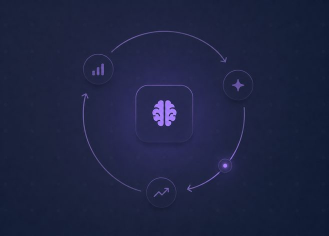
- Processes are continuous, not episodic. In a traditional company, work happens when a person shows up. In an autonomous company, work happens all the time. Content is published, leads are worked, pipelines are reviewed, and reports are compiled at machine speed — on cadence, without interruption, and without anyone manually kicking off the cycle.
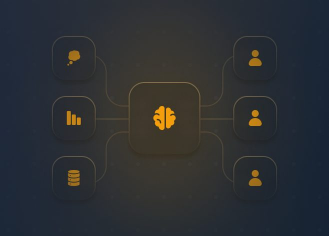
- The org chart is an agent hierarchy. Roles are not filled by headcount. They are filled by capabilities. A content function, a demand gen function, a customer intelligence function — each is a cluster of agents that collaborate, self-assign tasks, and escalate only when human judgment is genuinely required.
The Architecture of an Autonomous Company
Layer One — The Agent Workforce
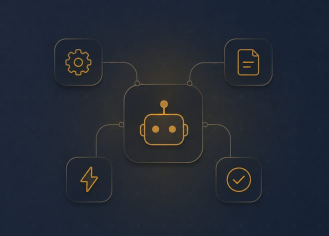
The base layer of an autonomous company is its agent workforce. These are not chatbots or copilots. They are operational agents — each assigned a function, a set of tools, a mandate, and the autonomy to execute against it without a human in the loop for every step.
A content writer agent drafts, edits, and publishes blog posts calibrated to the ICP and the editorial calendar. A demand gen agent identifies target accounts, initiates outreach sequences, and routes warm leads to the right follow-up flow. A finance agent closes books, flags variance anomalies, and surfaces exception reports. None of these agents wait for a human to click "go." They run on schedule, on trigger, or on task assignment — continuously.
The productivity differential between this model and the SaaS-assisted model is not marginal. It is architectural. You are not giving a human a faster tool. You are replacing the human as the executor of routine, repeatable, scalable work.
Layer Two — Orchestration and Delegation
A single agent executing in isolation is not an autonomous company. It's an automation. The differentiating infrastructure is multi-agent orchestration: the ability for agents to decompose complex goals, delegate sub-tasks to specialist agents, monitor execution, and re-route when something breaks.
This is the management layer — running at machine speed. When a growth objective requires coordinated output across content, SEO, distribution, and analytics, the orchestration layer decomposes that objective into work units, dispatches each to the right agent, aggregates the results, and surfaces the outcomes for human review. No project manager required. No weekly sync. No status update email.
Layer Three — The Governance Stack
This is where most visions of autonomous companies stall — and where serious platforms separate themselves from funded demos.
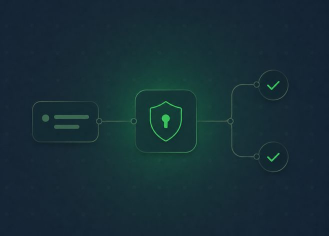
Autonomy without governance is chaos. An agent workforce that can act without constraints is not an asset. It is a liability. The governance layer is what makes autonomous operations commercially safe — and what makes the CFO, the GC, and the board willing to sign off on deploying it at scale.
The governance stack in a production-grade autonomous company includes:
- Human approval gates for consequential or irreversible actions — publishing to the public web, initiating financial transactions, sending customer communications
- Budget controls that cap AI spend at the agent, function, and workspace level, with hard stops and soft alerts
- Quality thresholds that route outputs to human review before they ship, based on confidence scoring or output classification
- Audit trails that log every agent decision, tool call, and task outcome for compliance, retrospective analysis, and debugging
- Drift detection that monitors outputs for brand, tone, and policy violations — catching regression before it compounds
Governance is not a feature to be added later. It is the operating infrastructure that determines whether the autonomous company is viable — or a liability waiting to surface.
Why the Window Is Now
The building blocks for the autonomous company have only recently converged: large language models capable of multi-step reasoning and reliable tool use; agent frameworks that support multi-agent coordination at production scale; cloud infrastructure cheap enough to run continuous agent workloads without enterprise-only economics; and API ecosystems rich enough to give agents real operational leverage across marketing, sales, finance, and operations.
A Gartner analysis from early 2025 projected that by 2028, 33% of enterprise software applications will include agentic AI capabilities — up from less than 1% in 2024. That is not incremental adoption. That is a category forming in real time.
For founders, this is a category-creation moment. Rarer and more structurally valuable than a feature gap or a market segment play. The platforms being built today will define the defaults — the operating assumptions, the workflow primitives, the governance standards — for the next decade of business operations.
For investors, the question is not whether this transition happens. It is who owns the infrastructure layer when it does, and whether the companies they are backing have built for the full stack — agents plus orchestration plus governance — or just the most visible layer.
The Human Role in an Autonomous Company
This is the question founders ask most often: if agents do the work, what do humans do?
The same things they have always done best. Humans set vision and strategy. Humans make judgment calls in ambiguous or genuinely novel situations. Humans build customer relationships that run on trust, not throughput. Humans govern the system — reviewing outcomes, adjusting policy, and deciding when the machine needs to be overridden.
What humans stop doing is executing routine, repeatable tasks that software can now do reliably, continuously, and at scale. Drafting the same content brief. Pulling the same weekly report. Coordinating the same handoff between systems. These are not tasks that required human judgment. They required human time — and that time is recoverable.
The shift is not humans out. It is humans up. The autonomous company is not a replacement for a team. It is what makes a small team capable of operating at the velocity and coverage of a much larger one.
The Governance Question Remains Open
The technical infrastructure for autonomous operations exists. The governance infrastructure is still being built — and this is where the real differentiation will emerge over the next two to three years.
The critical open questions are not theoretical. They are live engineering problems:
- How much autonomy is appropriate for which classes of decisions — and who configures those thresholds?
- Who is accountable when an agent makes an error with material business consequences?
- How do you maintain brand, legal, and regulatory compliance in an agent-executed operating environment?
- How do you prevent small agent errors from compounding into large organizational failures before a human notices?
The platforms that solve these problems at production scale — not as disclaimers in a demo, but as first-class infrastructure in the product — will define the autonomous company category. The ones that don't will be powerful tools with narrow deployment surfaces. There is a significant difference between the two.
The Post-SaaS Era Starts Now
The SaaS era gave business a generation of tools. The post-SaaS era gives business a workforce.
The autonomous company is not a prediction about what the future might hold. It is an engineering project already underway — at a small number of companies that have understood what the next paradigm actually requires and have built for the full stack, not just the most legible layer.
The org structure, the operating model, and the governance infrastructure are being assembled now. The category is being defined now. The defaults that will govern how AI-native companies operate for the next decade are being set now.
If you are building a company, scaling a function, or allocating capital toward the future of business operations, the relevant question is no longer which SaaS tools do I need? The relevant question is: what does my company look like when the software does the work?
That question has an answer. The teams building it are moving fast. The window to shape the answer — rather than inherit it — is open, but it won't stay open indefinitely.
Harnyss is building the autonomous operations platform for the post-SaaS era — agents, orchestration, and governance in one system. Learn more about how Harnyss works, or explore the platform capabilities that make autonomous operations commercially viable today.
Frequently Asked Questions
What exactly is an autonomous company?
An autonomous company is one where AI agents execute the routine operational work — content production, demand generation, financial reporting, customer operations — continuously and without human intervention at the task level. Humans set strategy, govern the system, and approve consequential decisions. The agent workforce handles execution.
How is autonomous operations different from robotic process automation (RPA)?
RPA automates deterministic, rule-based tasks by scripting exact sequences of actions. It breaks when the environment changes. Autonomous operations use AI agents that can reason, adapt to novel situations, decompose complex goals, delegate sub-tasks, and act across heterogeneous tools — without brittle scripts or manual exception handling.
Is the autonomous company model safe enough for businesses to adopt today?
Safety depends entirely on the governance architecture. Platforms that include human approval gates, budget controls, quality thresholds, and audit trails make autonomous operations commercially viable at scale. Without that governance infrastructure, the compounding risk of agent errors outweighs the efficiency gains. The governance stack is not optional — it is the product.
Which business functions are ready for autonomous execution today?
Strong early candidates include content production and distribution, SEO operations, lead enrichment and outreach sequencing, financial reconciliation and variance reporting, and operational data aggregation. Functions requiring nuanced judgment, novel problem-solving, or high-trust relationship dynamics remain human-led — with AI agents in a support and execution capacity.
What should founders and investors look for in an autonomous operations platform?
Look for governance infrastructure, not just agent capability. A platform that executes autonomously but cannot be safely governed at scale is a liability with a fast demo. The differentiating infrastructure is human approval gates, budget controls at the agent and function level, audit logging, quality thresholds, and drift detection. Capability without governance is a feature. Capability with governance is a platform.
Sources
- McKinsey & Company — "The State of AI in 2024" — https://www.mckinsey.com/capabilities/quantumblack/our-insights/the-state-of-ai
- Gartner — "Predicts 2025: Agentic AI Is Reshaping Enterprise Software" — https://www.gartner.com/en/newsroom/press-releases/2025-agentic-ai-enterprise-software