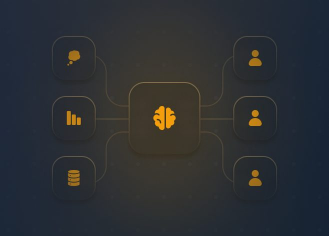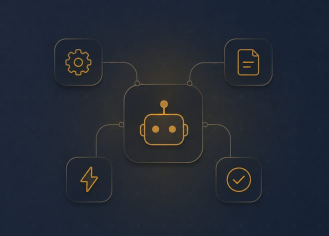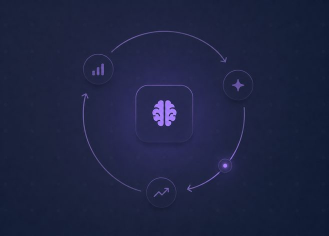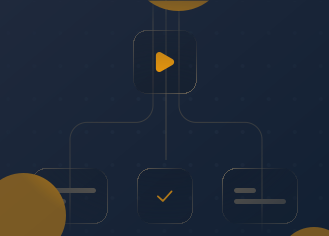

A customer's payment fails on a Friday night. Workflow automation does exactly what it was told: wait three days, send the reminder, wait three more, send the warning, suspend the account on day fourteen. It runs that same sequence for a brand-new trial and for the three-year customer whose card simply expired — because someone wrote those steps in advance, and following them is the only thing it can do. A system of operation does the thing a script can't: it looks at which customer this is and decides what to actually do. That gap — between following steps and deciding them — is the whole difference, and it is larger than it first looks.
The difference, in plain terms
Workflow automation runs a sequence of steps a person set up ahead of time. Give it the same input and it produces the same output, every time. The thinking — what to do, in what order, under what conditions — happened once, in advance, in the head of whoever built it. The running system doesn't think. It follows.
A system of operation works the other way around. You don't hand it the steps; you hand it the goal — recover the revenue without driving away good customers — and it works out the steps itself, in the moment, by looking at the actual situation in front of it. It does that fresh every time, including in situations nobody planned for.
So when that payment fails, the two behave nothing alike. The automation runs its ladder and suspends on schedule, even when suspending a loyal customer over an expired card is the worst possible move. The system of operation notices that this is a three-year account, that the card expired rather than bounced, that there's a renewal already in flight — and it sends a quiet "update your card" nudge instead of a threat. Same trigger, completely different behavior, because one is following a script and the other is reading the situation.
Why this isn't just better automation
The natural assumption is that this is a spectrum: start with simple automation, add enough rules and branches and AI-powered steps, and you eventually arrive at a system of operation. You don't — and the reason is simple once you see it.
Every rule you add is still a step someone wrote in advance. More rules make the list longer and the branching cleverer, but the system is still doing one thing: following a list. What it can't do, at any length, is handle the case that isn't on the list. And the case that isn't on the list is exactly the one you needed handled — because the situations that hurt most are the ones nobody saw coming.
That's why piling on rules never turns into deciding. They're two different activities. Following a longer script is still following a script. Working out what to do when there is no script is a different ability altogether, and a system of operation has it because something underneath is genuinely reasoning toward the goal instead of matching an input against a list.
This is what "something entirely new" actually means. Not a faster, smarter automation. A different kind of software: one that decides, where the old kind could only follow.
The same pattern in a different corner of the business
Billing is one example. Here's another, so the pattern doesn't look tied to one domain.
A monitoring alert fires at 2 a.m. Workflow automation opens a ticket, pages the on-call engineer, starts a call bridge, and posts a status update every thirty minutes. Useful, dependable plumbing — and completely blind to what's actually happening. It can't tell that three alerts are really one root cause, can't judge whether this is a bad deploy to roll back or a vendor outage to wait out, can't decide the problem is now big enough to wake the VP.
A system of operation does the part that needs judgment. It ties the three alerts to one likely cause, rolls back the suspect deploy because that's reversible and already approved, and stops cold at the line that needs a human — touching the production database — and asks. It drafts the customer status update from what it has actually confirmed, escalates by real severity, and remembers the failure so the next one resolves faster.
In both stories, notice what automation is missing: anyone deciding. It moves things along. It doesn't run the function.
What it takes to do this safely
Software that decides and acts on its own — rather than suggesting to a person who decides — needs things a workflow never did, because a workflow always had a human standing next to it supplying them. It needs permission: what it's allowed to do, on whose behalf, and where it has to stop and ask. It needs memory of your specific business, so its decisions sharpen over time instead of starting from zero. It needs to coordinate, so a dozen of these don't trip over each other. And it needs hard limits it cannot cross, built on the assumption that its reasoning will sometimes be wrong.
That — not an "autonomous mode" switch added to a rules engine — is the real work, and it's most of why this is hard. We've written up how those guardrails get built in harness engineering, and how agents, copilots, and automation actually fit together in a separate breakdown.
Where Harnyss fits
A system of operation is a kind of software the whole industry is moving toward. We didn't name it, and we won't be the only ones building it. What we're focused on is narrower and harder: shipping the first version solid enough that a real business can hand it an entire function. The reasoning runs on the Claude Agent SDK — Anthropic's models do the thinking — and what we build around it is the permission, memory, coordination, and limits that make that thinking safe to leave alone. The fuller case for why this is a genuine new category is in the anchor piece.
What changes
For as long as business software has existed, the steps were decided by a person — either in the moment, by hand, or once, in advance, frozen into a workflow. Either way, a human did the deciding. What's new is software you can hand the deciding to: give it the goal and the limits, and let it work out the steps. The question stops being "what sequence do I need to build" and becomes "which functions am I ready to hand over." And that shift doesn't stop at a single function — it runs all the way up to the company itself.