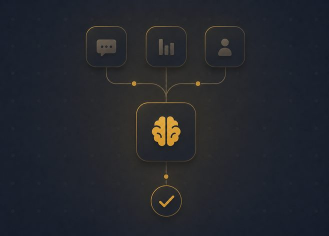
For as long as companies have existed, scaling output meant scaling headcount: to do more, you hired more. That equation is coming apart. A small team can now operate at the scale of a much larger one — not by working inhuman hours, but by running its functions on a system that does the operating. We're not speculating about this. We run our own company that way.
The math that used to be fixed
Output scaled with people. Every additional unit of work — another market, another product line, another hundred customers to support — eventually meant another hire, then another manager, then another layer. Capital became headcount became output, with overhead lost at each conversion. A five-person company did five people's worth of work. To do fifty people's worth, you became a fifty-person company, with everything that entails: recruiting, onboarding, coordination cost, and the management tax that grows faster than the team does.
That conversion is what's changing. Output is decoupling from headcount — and once it does, the question a small company asks about growth stops being "who do we hire" and starts being "what do we want this function to do."
What "operating like fifty" actually means
It is not five people working ten times harder, and it isn't magic. It's that the operating work of each function runs on a harness. The people set direction and make the judgment calls; the functions — marketing, sales, customer success, finance, the connective operational tissue between them — run continuously underneath, governed, without a person performing each step.
We run our own company this way
We build Harnyss. We also run a company on it. Reporting Hub — our insight orchestration and delivery platform, which lets businesses share their business intelligence and AI insights at scale outside their own organization, securely and fully governed — runs its operations entirely on Harnyss. The team is five people. Harnyss runs all of our business processes.
Those last two numbers usually move in opposite directions. Cutting operating cost normally means doing less; raising output normally means spending more. We did both at once, because the cost of running a function stopped being tied to how many people we put in front of it. The functions kept running — they just stopped requiring a person at each step to run.
There's a reason this fits us specifically. Reporting Hub exists so companies can push intelligence beyond their own walls under tight control — the right people see the right insight, with governance and a full record of who saw what. We run the company itself on the same principle: the functions operate on their own, but inside defined boundaries and a complete audit trail. Governed autonomy is both the product we sell and the way we operate.
This is leverage, not just automation
The instinct is to file this under automation, but the distinction is the whole point. Automation runs a fixed script and breaks the moment reality does something the script didn't anticipate. What we're describing exercises judgment — it works out what to do when the situation is novel, which in real operations is most of the time. Each function runs inside a mandate it cannot exceed, with approval gates wherever we want a human in the loop, and a full trail of every action. That's the difference between work you can hand to a system and trust, and work you have to re-check afterward — and re-checking everything is just the old job with extra steps.
What actually changes for a small company
The binding constraint moves. For a small team it has always been people: there's only so much five of you can do, so growth meant hiring, and hiring meant capital and time you might not have had. When the functions run on a harness, the constraint shifts from headcount to direction — from "can we afford to staff this" to "do we know what we want this function to do, and where we want to keep our hands on the wheel."
This isn't a story about doing the same work with fewer people. It's about a small team attempting things that used to require a large one — entering a market, supporting a real customer base, running a full operation — at a size where, a few years ago, you simply couldn't have. The leverage doesn't shrink the ambition to fit the team. It grows what the team can reach for.
The interesting companies of the next few years won't be the ones that hired the fastest. They'll be the small teams that learned to operate like large ones, and kept their attention on the decisions that genuinely needed a human. We're betting our own company on it.
If you want the broader argument, we've written about the self-operating company and what it looks like when the org chart itself becomes software. Or start a free trial and run a function of your own on it.