
The org chart is one of the oldest pieces of software in any company, and until recently it didn't run on anything. It is a specification — who does what, who reports to whom, what gets escalated and to whom — that has always been executed by people. What happens when the boxes can be filled by software? The diagram stops describing the organization and starts being it. That is a stranger and larger change than it sounds, and it's the one underneath everything else happening in AI operations right now.
The org chart was always a specification
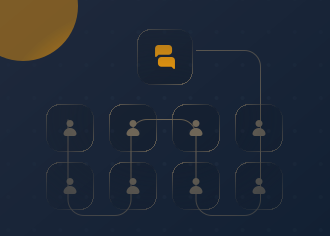
Look at an org chart and notice what it actually encodes. The boxes are roles, each with a mandate — a scope of work and a scope of authority. The solid lines are reporting and delegation: who hands work down, who answers upward. The dotted lines are coordination across functions. The unwritten escalation paths describe what happens when something exceeds a role's authority — it goes up until it reaches someone who can decide.
That is a precise specification for how work flows, who is accountable, and where decisions get made. We draw it as a diagram and pin it to a wall because, for a hundred years, the only thing capable of executing it was people. The chart was never the organization. It was the program, and people were the runtime.
We just never had anything else to run it on.
Making the structure executable
An agent in the "Sales" box carries the Sales mandate and only that mandate. It reports along the line the chart draws. When it hits something above its authority — a discount past a threshold, a contract term it can't approve — the escalation path is real and enforced, not aspirational. The chart is no longer a picture of how the company is supposed to work. It is how the company is working, right now, this minute.
That is the structural change. Not "we added AI to the company." The shape of the company — its roles, its lines, its chains of accountability — became something you can configure, run, and watch execute.
What a flowchart can do, and what an organization can
The obvious objection: isn't this just a flowchart? Workflow automation has let people draw boxes and arrows for years. Tie them to agents and you have a fancier flowchart. Right?
No — and the gap between the two is the entire point. A flowchart routes a task along a predefined path. An organization is a different kind of object, and it differs in exactly four ways. These four are not features you add on top of a flowchart; they are what you must build to turn a drawing of an org into an executable one.
- Authority, not just sequence. A flowchart says what happens next. An organization says who is allowed to make a given decision, on whose behalf, with what oversight. Execution without an authority model is just motion.
- Graceful handling of the unscripted. A flowchart fails the moment reality does something it didn't anticipate. An organization absorbs the unscripted — it reassigns, escalates, asks, and adapts. Real operations are mostly the unscripted; a structure that can't handle it isn't running a function, it's running a demo.
- Memory. A flowchart is stateless; it knows nothing between runs. An organization accumulates judgment about its own business — what was tried, what worked, who the customers are, where the constraints sit. That memory is most of what makes a five-year employee worth more than a new hire.
- Boundaries. An organization constrains its members to their mandate, structurally, so that a single bad decision can't reach across the whole company. Not a guideline — a rail.
A system with none of these is a conveyor belt, which is exactly what workflow automation is — and why, however sophisticated it gets, it never becomes an organization. Making an org chart executable means building these four. We've written about that build in detail in harness engineering; they are the difference between a diagram that runs and a diagram that merely moves things along.
You don't operate it. You run it.
When the org chart is software, the verbs of running a company turn into operations on that software.
Hiring becomes configuring a role — defining a mandate, a reporting line, an autonomy level — rather than a months-long search. Managing becomes setting objectives and reviewing outcomes rather than assigning and chasing tasks. Reorganizing becomes editing the structure and watching the new shape take effect, rather than a quarter of change management. Delegation, oversight, escalation, restructuring — the actual work of running an organization — become things you do to a live system.
This is why operating a platform like this feels less like using an app and more like running an organization. That's not an analogy. Structurally, that is what it is.
What this is and isn't
It is worth being precise, because the claim invites a caricature. This is not "fire everyone and run the company from a laptop." The humans do not vanish from the chart — they move to the top of it, into the roles that are about direction, judgment, and the calls that should never be automated. What changes is that the structure beneath them executes instead of waiting to be executed by hand.
And it is not a claim that anyone invented the org chart, or management, or the idea that companies have structure. Obviously not. The claim is narrower and stranger: the org chart can now be a live system instead of a poster on the wall — and building the version that actually works, governed and accountable and safe, is the real work. The idea is old. The runtime is new.
The org chart was always the program
For a century, the most consequential software in any company was the one nobody called software: the structure of roles and accountability we drew on a chart and ran on people. It is becoming executable. The companies that internalize this won't think of themselves as buying a tool — they'll think of themselves as designing an organization and then running it.
The org chart was always the program. We finally have something other than people to run it on.
This is one of three pieces on that shift. The companion essays make the case that this is a new category of software and look at what it means for the company that runs on it.