
By 2026, the bottleneck in deploying AI to a real business stopped being model quality. Frontier models could draft emails, write code, query databases, and reason about complex situations as well as a competent junior employee. The bottleneck became something else: nobody had figured out how to make a fleet of these capable models actually run a business — reliably, auditably, week after week. The term the AI industry settled on for the discipline that solves it is harness engineering. This post is our take on what it means and what it takes to build one.
A definition
A model is a capability. An agent is a capability with a goal. A harness is the structure that turns a population of agents into a system that can be trusted to operate without continuous human supervision. It is the difference between "this AI is impressive in a demo" and "this AI runs a function of our business."
Why the existing words don't cover it
Before "harness engineering" caught on, teams reached for existing vocabulary. None of it covered the actual job:
- Prompt engineering is the practice of getting a single model call to produce the output you want. Important, but local. The interesting failures don't happen inside a single call.
- Agent engineering describes the construction of one autonomous agent — its tool use, its reasoning loop, its memory. Also important, also local. The interesting failures are between agents and across time.
- MLOps is about training pipelines, model versioning, and deployment infrastructure. It assumes the model is the artifact. In agentic systems, the model is a commodity input; the artifact is the behavior of the system around the model.
- Orchestration describes the mechanics of moving work between components. It is a means, not an end. You can have orchestration without governance and end up with a faster way to make mistakes.
The thing missing was the complete operating environment for autonomous AI inside a real organization — the structure that makes a fleet of agents safe, accountable, and continuously improving. Calling that a harness, and the work of building it harness engineering, is the framing the industry has converged on. It's the right one.
The four pillars
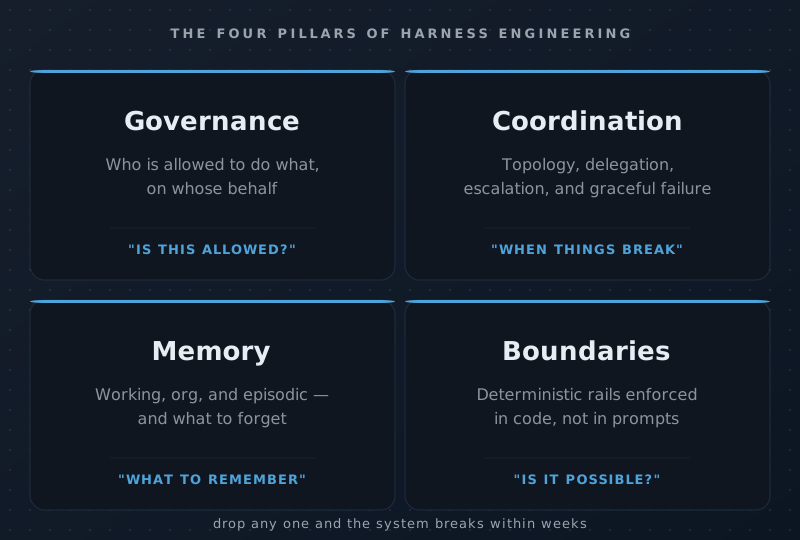
Every production-grade harness we have shipped — and every credible one we have studied across the industry — has the same four pillars. Drop any of them and the system breaks down within weeks.
1. Governance
Who is allowed to do what, on whose behalf, with what oversight? Governance is the layer that decides whether an agent's intended action is permitted, whether it requires human sign-off, and what record is kept of the decision.
In practice this means: role-based authority (a CMO Agent has different write permissions than an SDR operator), approval flows that scale (low-risk auto-approves, medium-risk batches into digests, high-risk interrupts immediately), and immutable audit trails so any action can be reconstructed and attributed after the fact. Governance is what makes the system defensible to a board, an auditor, or a regulator.
A harness without governance is a fast way to lose control of a function you used to run by hand.
2. Coordination
A single agent can do useful work. A fleet of agents working on a shared business goal needs coordination — a topology, a delegation pattern, an escalation policy. Coordination is the discipline of making many agents behave like one organization rather than like a thousand independent contractors with overlapping responsibilities.
The hardest part is not the topology — it is the graceful failure mode. What happens when an agent gets stuck? Spawns too many sub-agents? Hits its budget? Encounters a question outside its competence? The coordination layer is what routes those situations: bounded retries, escalation to a parent agent, escalation to a human, partial-result surfacing, time-to-live cutoffs.
Coordination without graceful failure is a system that works perfectly until it doesn't, and then can't tell you why.
3. Memory
Agents that don't remember anything are tools. Agents that remember the right things, in the right form, at the right granularity are colleagues. Memory is the pillar that turns one-shot AI calls into a system that learns the business it operates in.
There are at least three kinds of memory a harness has to manage:
- Working memory — the live context for the task in flight. Easy to overdo; gets expensive fast.
- Org memory — facts the system has learned about the business, its customers, its constraints. Stable, queryable, structured.
- Episodic memory — what happened, when, and why. Powers retrospection, post-mortems, and the slow accretion of taste.
Memory engineering is mostly about what to forget. Stuffing every interaction into a vector store does not produce a system that gets smarter over time; it produces a system that gets noisier.
4. Boundaries
The fourth pillar is what we call boundaries — the deterministic rails that constrain agent behavior to the legitimate space of action. Boundaries are not the same thing as governance: governance asks "is this allowed?", boundaries ask "is this even possible?"
Boundaries are enforced in code, not in prompts. Tool schemas that physically can't take destructive actions. Spend caps that block transactions before they reach a payment processor. Domain allowlists that prevent an agent from emailing outside an approved list. Read-only modes for sensitive integrations. The principle: assume the model is occasionally wrong, and design rails such that the wrongness can't escape.
A harness without boundaries is a harness that is one bad day away from a public incident.
The model is not your product, and the agent is not your product. The harness is your product.
Harnyss Team
Where harness engineering sits
These layers compose. A serious AI deployment uses all of them. But the layer that is most often missing — and most often responsible for projects stalling between pilot and production — is the harness.
When you need a harness (and when you don't)
You don't need a harness if:
- You're using AI as a personal copilot.
- You have a single agent doing a single, low-stakes task with a human reviewer in the loop.
- The cost of a wrong action is low and easily reversible.
You need a harness the moment any of these become true:
- An agent's actions affect external parties (customers, partners, regulators).
- The cost of a wrong action is high or hard to reverse (spend, contracts, sensitive comms).
- More than one agent has to coordinate on a shared business outcome.
- The system needs to keep working when the people who built it are not paying attention.
In other words: as soon as you stop treating AI as a productivity tool and start treating it as something that runs a function, you are in harness territory whether you have engineered one deliberately or not. The question is whether your harness is intentional or accidental.
What this means in practice
The takeaway for anyone deploying AI at organizational scale: the model is not your product, and the agent is not your product. The harness is your product. The model gets cheaper and more capable every quarter. The differentiation, the durability, and the defensibility of an AI deployment all live in the harness around the model.
The industry has named the problem. Most teams are still solving it from scratch — six to twelve months of internal engineering before the first production agent does anything trustworthy. Harnyss exists to make harness engineering a thing you adopt, not a thing you build. We ship the four pillars — governance, coordination, memory, boundaries — as a product, so the model and the agents inside it can do their work, and you can trust the results from day one.
If you want a deeper look at how we implement each of the four pillars in production, our engineering blog has detailed write-ups on approval flows, audit trails, and emergent delegation. Or if you'd rather see the harness running in your own org, start a free trial.