
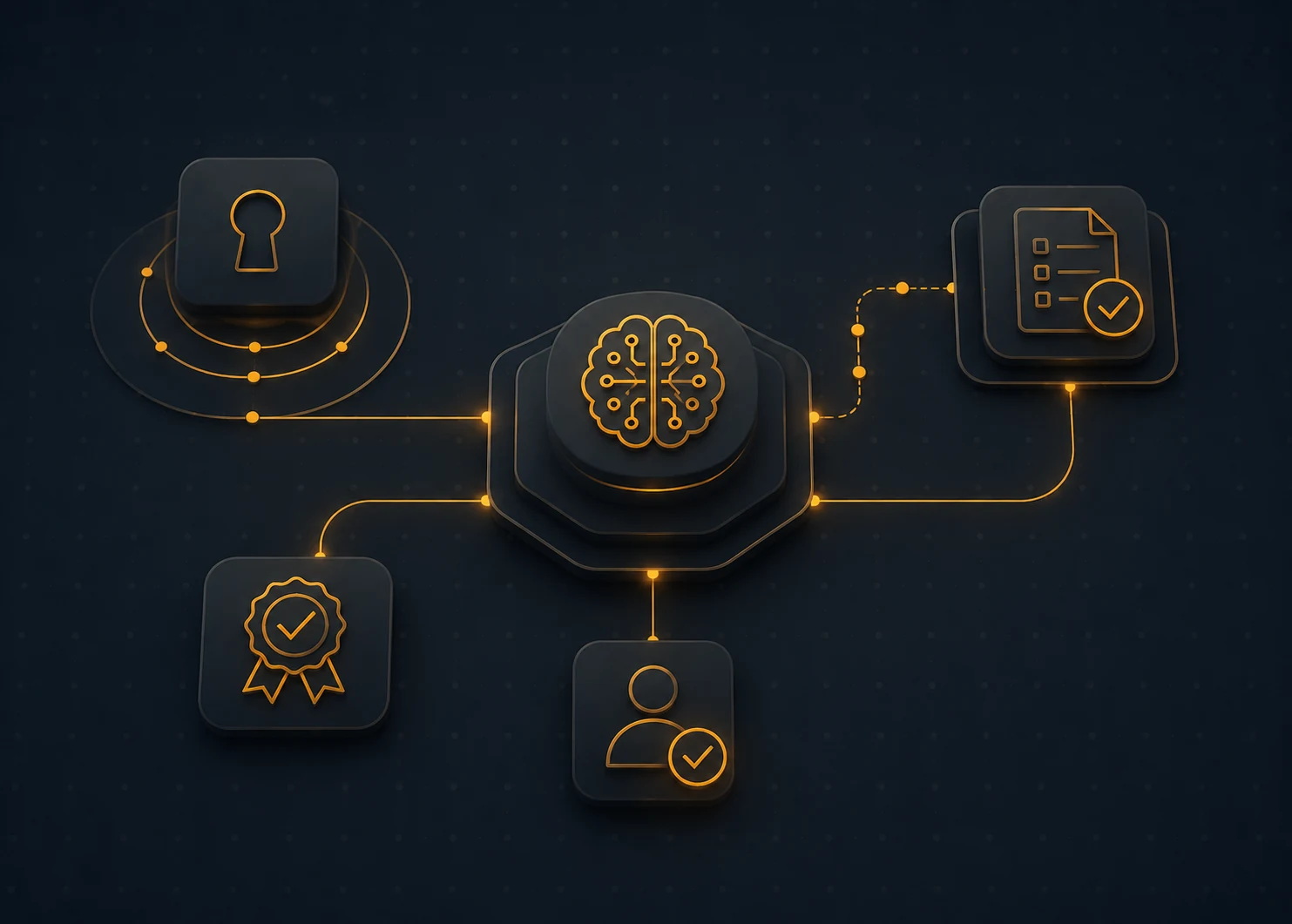
For enterprises deploying agents that read records, call APIs, move money, or push code, closing that gap is the real work. This guide covers every layer of enterprise agent governance — from identity and permissions through audit trails, compliance frameworks, and coding agent controls.
Key takeaways
- Governance debt compounds; address it before production.
- Give every agent its own identity and credentials.
- Separate tool access from action-level authority always.
- Delegated authority can never exceed original permissions.
- Audit trails must let you reconstruct any decision.
- Map controls to NIST, ISO 42001, and SOC 2.
- Coding agents need enforcement, not just policy files.
What Is AI Agent Governance?
AI agent governance is the set of policies and technical controls that define what an autonomous agent can access, decide, and do. It sits closer to identity and access management than to content moderation, because the risk is not a bad sentence but a wrong action taken with real permissions. Traditional AI governance asked whether a model's output was accurate or fair; agent governance asks whether the system was authorized to act at all.
That distinction matters most as agents move from answering questions to taking actions with lasting consequences: updating a record, issuing a refund, deploying code, or contacting a customer. Traditional software had this boundary built into its architecture, since every action mapped to a fixed, reviewed code path. Agents blur that boundary because the same model can reason its way into actions nobody explicitly coded, which is why permissions and oversight have to be enforced outside the model itself.
The Five Questions Every Governance System Must Answer
Who is acting?
Every governed system must identify the specific agent identity and credential that initiated a given action or request.
What are they allowed to access?
Every governed system must define exactly which systems, data, and tools an agent is permitted to reach at all.
What are they allowed to do?
Every governed system must specify which actions an agent can take, distinct from which resources it can merely view.
Who is accountable?
Every governed system must assign a named owner responsible for an agent's behavior, outcomes, and any resulting incidents.
Can the action be reconstructed later?
Every governed system must retain enough detail to recreate exactly what an agent did, why, and under whose authority.
The Cost of Governance Debt
Governance debt accumulates quietly, because the same shortcuts that make a prototype fast to build are the ones that make it dangerous to operate at scale. Left unaddressed, that debt surfaces at the worst possible moment: after an agent already has production access.
Why Prototypes Hide Governance Problems
- Demo data hides real access risk
- One shared API key covers everything
- No approval step slows the demo
- Success metrics ignore security by default
- Small blast radius masks bigger exposure
The Prototype-to-Production Governance Gap
What Governance Debt Looks Like
- Agents sharing one privileged service account
- No record of who approved access
- Permissions granted once, never reviewed again
- Unclear ownership when incidents actually occur
- Logs too thin to reconstruct decisions
Which Risks Should Enterprise Agents Be Governed Against?
Autonomous agents fail differently than traditional software, because a single flawed decision can cascade into real-world actions before anyone reviews it.
Excessive Authority
An agent accumulates excessive authority when its permissions are scoped to what might be useful rather than what a specific task requires. This often happens gradually, as teams grant broader API or database access to avoid repeated permission requests during development.
Unauthorized Tool Use
Connecting an agent to a tool does not mean every function of that tool should be available to it. Without action-level restrictions, an agent that only needs to read Salesforce records can just as easily update, export, or delete them.
Data Leakage and Context Contamination
Agents that pull data from multiple sources risk carrying sensitive information into contexts where it does not belong. Context contamination compounds the problem over multi-step workflows, since information gathered early in a task can quietly influence decisions made much later.
Prompt Injection and Indirect Manipulation
Prompt injection lets an attacker embed instructions inside content an agent processes, such as a webpage, email, or document, hoping the agent treats those instructions as legitimate commands. Effective defenses rely on permission boundaries and action approval rather than trying to filter every possible injected phrase.
Model Opacity and Unexplained Decisions
Agents built on large language models do not always produce a clear, auditable rationale for why they chose one action over another. Logging the reasoning trace, tool calls, and inputs behind each decision is the practical substitute for a fully explainable model.
Bias and Unfair Outcomes
Agents trained or prompted on historical data can reproduce and amplify patterns of bias present in that data, particularly in HR, lending, and customer-service contexts. Unlike a single biased output from a chatbot, a biased agent can take repeated actions at scale before anyone notices the pattern.
Delegation and Cascading Agent Failures
When one agent can assign work to another, an error or compromise in the first agent can propagate through every agent it delegates to, often faster than a human could intervene. Limiting delegated authority to a subset of the delegating agent's own permissions contains the blast radius of any single failure.
Accountability Gaps
An accountability gap appears when an agent takes a consequential action and no individual or team can be clearly identified as responsible for it. Closing the gap requires assigning ownership at the point an agent is registered, not after something goes wrong.
How Should Permissions Work in an AI Agent Governance Framework?
Permissions should give every agent its own identity, grant only the minimum access a task needs, and separate tool from action authority.
Give Every Agent Its Own Identity
Every agent needs a unique machine identity, distinct from any human user and from any other agent. Credentials should be isolated per agent rather than shared across a fleet, so revoking one agent's access never touches another's, and rotated on a defined schedule so a leaked credential has a short useful life. Reusing a human employee's login for an agent erases this entire chain of accountability.
Least-Privilege Access
The agent receives only the minimum access required for its task. A collections agent illustrates the principle well:
Allowed
- Read outstanding invoices
- Send approved reminders
- Update payment status
Not Allowed
- Modify bank details
- Delete invoices
- Issue refunds
- Export the customer database
Role-Based Access Control (RBAC)
RBAC assigns permissions to a defined role — such as "collections agent" or "IT triage agent" — and assigns individual agents to that role rather than configuring access one at a time. It works well when an organization has a stable, predictable set of agent job functions. The tradeoff is granularity: RBAC struggles when access should depend on context.
Attribute-Based Access Control (ABAC)
ABAC evaluates a policy against the specific attributes of a request at the moment it happens. This makes it better suited than RBAC to fine-grained, context-dependent decisions — such as allowing a finance agent to approve a $500 refund automatically but requiring human approval above $5,000.
- Agent identity
- User identity
- Data sensitivity
- Geography
- Customer
- Department
- Transaction value
- Time
- Environment
Tool-Level vs Action-Level Permissions
Connecting an agent to a system should not automatically mean unrestricted access to everything that system can do. The distinction is critical:
Example — Stripe
Tool permission: Can use Stripe.
Action permission: Can view transactions but cannot issue refunds.
Data-Level Permissions
Beyond tools and actions, governance has to control which tables, records, tenants, knowledge sources, and PII categories an agent may access. A support agent scoped to a single customer's account should not be able to query records belonging to another tenant.
Just-in-Time and Temporary Authority
Not every permission needs to exist permanently. Permission may exist only:
- During a workflow
- For one request
- After approval
- For a specific customer
- Until a defined expiration
Delegated Authority Between Agents
- Can Agent A grant authority to Agent B?
- Can permissions be inherited?
- Can delegated authority exceed the original agent's authority?
- How is the delegation recorded?
Enterprise AI Agent Governance Across the Agent Lifecycle
Governance is not a one-time setup step; it has to travel with an agent from the moment it's created through every change made across its operational life.
Agent Creation and Registration
Every agent should be registered in a central inventory before it ever runs, with its identity, owner, purpose, and permitted tools documented at creation time. Without this step, organizations accumulate what security teams increasingly call shadow AI: agents running in production with no owner, no documented scope, and no way to revoke their access on demand.
Governance for Coding Agents
Coding agents introduce unique risks because they can change the systems other agents — and other people — depend on. A single agent capable of generating code, opening pull requests, modifying infrastructure, changing dependencies, running commands, and deploying software holds more leverage over the production environment than almost any other agent type in the enterprise.
Repository-Level Agent Policies
Governance files such as AGENTS.md and CLAUDE.md have become a common way to tell a coding agent what's expected of it: which directories are off-limits, which conventions to follow, which commands require a human to run instead. What they cannot do is enforce anything. A policy file is a request the agent is expected to honor, not a technical control it is unable to bypass.
Policy-as-Code
Policy-as-code tools such as Open Policy Agent (OPA) and Conftest let organizations write governance rules as executable policy, then run those rules automatically inside CI pipelines, infrastructure checks, and security gates.
Govern What Coding Agents Can Modify
Not every part of a codebase should be equally reachable by an autonomous agent. Restrictions commonly apply to:
- Authentication
- Payment systems
- Production infrastructure
- Secrets
- Security policies
- CI/CD pipelines
PR and Merge Controls
Coding agents may create pull requests without ever receiving permission to merge them. Enterprise governance should treat these as genuinely separate authorities:
Audit Coding-Agent Activity
Independent research adds urgency here: CodeRabbit's analysis of open-source pull requests found that AI-generated code introduced roughly 2.74 times more security vulnerabilities than human-written code — a gap wide enough that unreviewed agent commits deserve at least the same scrutiny as unreviewed human ones.
- Agent identity
- Prompt or task
- Files changed
- Commands run
- Dependencies added
- Tests executed
- Security findings
- Reviewer
- Merge decision
- Deployment result
What Governance Looks Like Across Business Functions
The same governance principles play out differently depending on what an agent is actually doing and which business function it sits inside.
Mapping AI Agent Governance to NIST, ISO 42001, SOC 2, GDPR, and the EU AI Act
No single framework was written specifically for autonomous agents, but each of the major standards enterprises already work with maps onto agent governance in identifiable ways.
NIST AI Risk Management Framework
NIST's AI Risk Management Framework organizes governance around accountability, risk ownership, documentation, monitoring, and human oversight. GOVERN 2.1 calls for documented roles and lines of communication for managing AI risk — in agent terms, naming who owns each registered agent and who is notified when it fails. GOVERN 2.3 places responsibility for AI system deployment decisions with executive leadership, meaning an agent capable of production actions should carry executive-level sign-off before going live.
ISO/IEC 42001
ISO/IEC 42001 certifies how an organization governs the lifecycle of its AI systems, including agents. It's distinct from ISO 27001, which covers information-security management generally. For agent governance, that means demonstrating AI system ownership, risk management processes, lifecycle stages from design through retirement, documentation requirements, and ongoing monitoring.
ISO 27001
ISO 27001 remains relevant to agent governance because agent identity, credential management, and access logging are, at their core, information-security controls. An organization already certified to 27001 has a head start on the identity and access management layer of agent governance, but 27001 alone says nothing about model behavior, decision explainability, or AI-specific lifecycle risk.
SOC 2
SOC 2's trust service criteria map onto agent governance with unusual precision: Access maps to agent identity and permissions. Change management maps to how agent updates and permission changes get reviewed. Logging maps to audit trails. Monitoring maps to runtime detection. Incident response maps to agent containment — the ability to revoke or pause an agent's access the moment something goes wrong.
GDPR
For agents that touch personal data, GDPR's core principles apply directly: personal-data access scoped to what a task actually requires, data minimization, purpose limitation, retention and deletion policies that account for agent logs and memory, and automated decision-making protections including a right to human review.
EU AI Act
The EU AI Act ties an AI system's obligations to its assessed risk level. Where an agent's use case is classified as high-risk, expectations center on risk management processes, record-keeping sufficient to reconstruct system behavior, human oversight, and clear accountability for outcomes. Note: the Act's high-risk obligations were deferred under the 2026 Digital Omnibus to December 2027 for most systems — treat the underlying requirements as a design target now.
Standards-to-Controls Matrix
What to Look for in an AI Agent Governance Platform
The right platform should make permissions, audit trails, and policy enforcement default behavior rather than something a team has to configure on its own.
- Native support for unique, per-agent machine identities and credentials
- Granular tool-level and action-level permission enforcement, not just connections
- A policy engine that supports both RBAC and ABAC models
- Immutable, exportable audit trails covering every agent decision and action
- Configurable human approval gates set per workflow and risk threshold
- Built-in mapping to frameworks such as NIST, ISO 42001, and SOC 2
- Real-time monitoring able to pause or revoke agent access instantly
Harnyss, for example, assigns every agent in its business hierarchy a defined mandate, scoped tool access, approval gates for high-risk actions, and a full audit log by default — the kind of architecture this list describes rather than a feature added after the fact.
Final Words
- Governance debt compounds; address it before production.
- Give every agent its own identity and credentials.
- Separate tool access from action-level authority always.
- Delegated authority can never exceed original permissions.
- Audit trails must let you reconstruct any decision.
- Map controls to NIST, ISO 42001, and SOC 2.
- Coding agents need enforcement, not just policy files.
Frequently Asked Questions
What is an AI agent governance framework?
It is the policies and controls governing agent access. It assigns identity, permissions, and accountability for every action an agent takes.
Why is AI agent governance different from AI governance?
It governs actions an agent takes, not just words a model generates. Content risk differs fundamentally from action risk.
What is shadow AI?
Shadow AI is an unregistered agent running without approval or oversight. It operates outside governance entirely, unseen and unaccounted for.
How can companies detect unauthorized AI agents?
Companies detect shadow AI through network monitoring, API usage audits, and mandatory agent registration. Unregistered credentials often reveal it first.
What should an AI agent audit trail include?
An audit trail should capture agent identity, inputs, actions taken, and outcomes. It must let anyone reconstruct exactly what happened.
Do AI agents always require human approval?
No, approval should scale with risk and reversibility. Low-stakes, reversible actions can run autonomously; high-stakes actions need review.
What is governance debt in AI systems?
Governance debt is the accumulated risk from skipping controls during prototyping. It surfaces once an agent reaches production.