
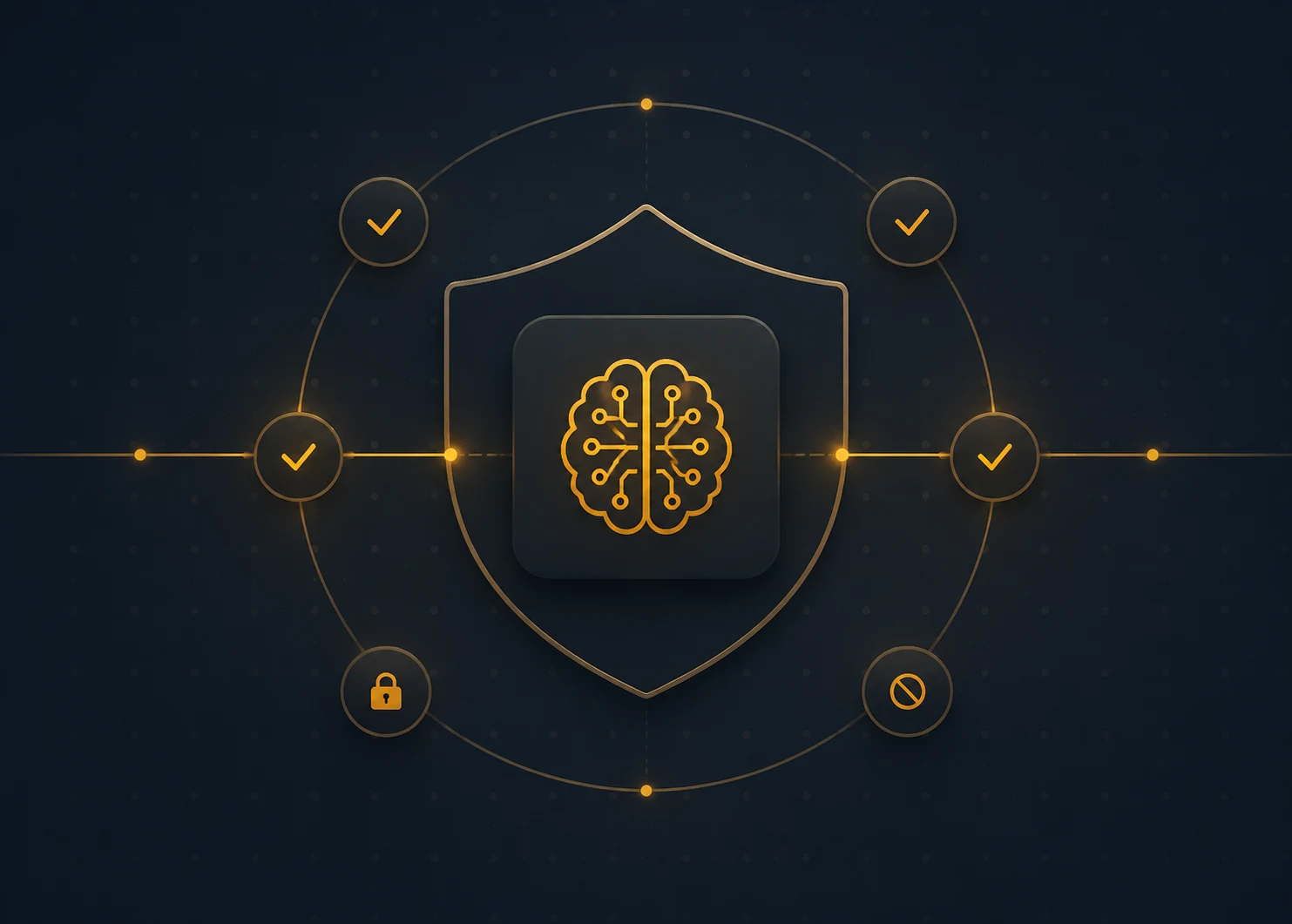
A guardrail isn't a polite instruction buried in a system prompt; it's an enforceable control placed at the layer where a specific risk actually shows up — whether that's the input reaching the model, the tools an agent can call, or the permissions attached to its identity. This article walks through the main guardrail types, shows where each one belongs in an agent's architecture, and explains how teams can balance safety with the autonomy that makes agentic AI useful.
Key takeaways
- Guardrails enforce constraints; governance sets policy and ownership.
- Strong controls sit closest to the resource being protected.
- Autonomous agents need layered controls across the full workflow.
- Risk-based rules match control strength to potential impact.
- Multi-agent systems need delegation and authentication controls too.
- Prompt instructions alone cannot stop determined or buggy agents.
- Human approval remains essential for high-risk, irreversible actions.
What Are AI Agent Guardrails?
AI agent guardrails are enforceable controls that constrain what an autonomous agent is allowed to see, decide, and execute at each stage of its workflow. They differ from prompt instructions because they operate as code, policy, or permission logic rather than as advice the model can choose to ignore. A single guardrail typically governs one narrow decision point, such as which tool can be called or which output format is acceptable.
Guardrails can be enforced at several distinct layers of an agent system, and each layer catches a different class of failure. Input, context, and model-level controls shape what the agent receives and how it reasons about a task. Tool, permission, action, workflow, output, and monitoring layers govern what the agent is technically able to do once it decides on a course of action.
None of these layers works well in isolation. A validated input can still lead to an unsafe action if permissions are too broad, and a well-scoped permission set can still be misused if the workflow allows unlimited retries. Effective guardrail design treats each layer as one link in a chain rather than a single gate the agent has to pass once.
Guardrails vs Governance
Guardrails are the specific technical and procedural controls enforced during execution, while governance is the broader organizational framework that decides which controls exist, who owns them, and how they're audited.
Why Do Autonomous Agents Need Stronger Guardrails?
Autonomous agents need stronger guardrails because they can act on their conclusions instead of simply presenting them for review. A chatbot that generates a wrong sentence produces a bad paragraph; an agent that acts on a wrong conclusion can send a payment, delete a record, or notify the wrong customer. The more steps an agent can take without a human in the loop, the more guardrails have to do the job a person would otherwise be doing.
Agents Can Create Side Effects
Agents can create side effects the moment they call a tool, update a system, or send a message on a user's behalf. Unlike a text response, a side effect can persist, propagate to other systems, or trigger downstream automations that are hard to reverse. A guardrail at the action layer is what actually stops an unwanted side effect, not a note in the prompt telling the agent to be careful.
Errors Can Compound Across Steps
Errors can compound across steps because an agent's output at one stage often becomes its input at the next. A small misclassification early in a task can cascade into a wrong tool call, a bad parameter, or an incorrect approval decision several steps later. Guardrails placed throughout the workflow catch problems before they accumulate into something harder to unwind.
Agents Can Use Untrusted Information
Agents can use untrusted information pulled from documents, web pages, emails, or tool outputs that were never meant to be instructions. A malicious or malformed piece of content can attempt to redirect the agent's behavior through embedded text — a technique commonly known as prompt injection. Context and input guardrails are what separate legitimate task data from content that's quietly trying to steer the agent.
Delegation Expands the Risk Surface
Delegation expands the risk surface because one agent can hand work to another agent, which may have different permissions, context, or safety controls. A task that was safely scoped for the first agent doesn't automatically stay scoped once it's passed along. Multi-agent guardrails exist specifically to prevent an action that was blocked for one agent from becoming executable simply because a different agent requested it.
Memory Can Preserve Bad Information
Memory can preserve bad information long after the original mistake has been corrected elsewhere in the system. An agent that stores an incorrect fact, a stale permission, or a poisoned instruction may keep acting on it across unrelated future sessions. Memory guardrails limit what gets retained, for how long, and under what provenance rules before it's trusted again.
Main Types of AI Agent Guardrails
Agentic AI guardrails aren't one control — they're a set of distinct mechanisms that each protect a different layer of an agent's workflow. The ten types below cover what shows up most often in production agent architectures.
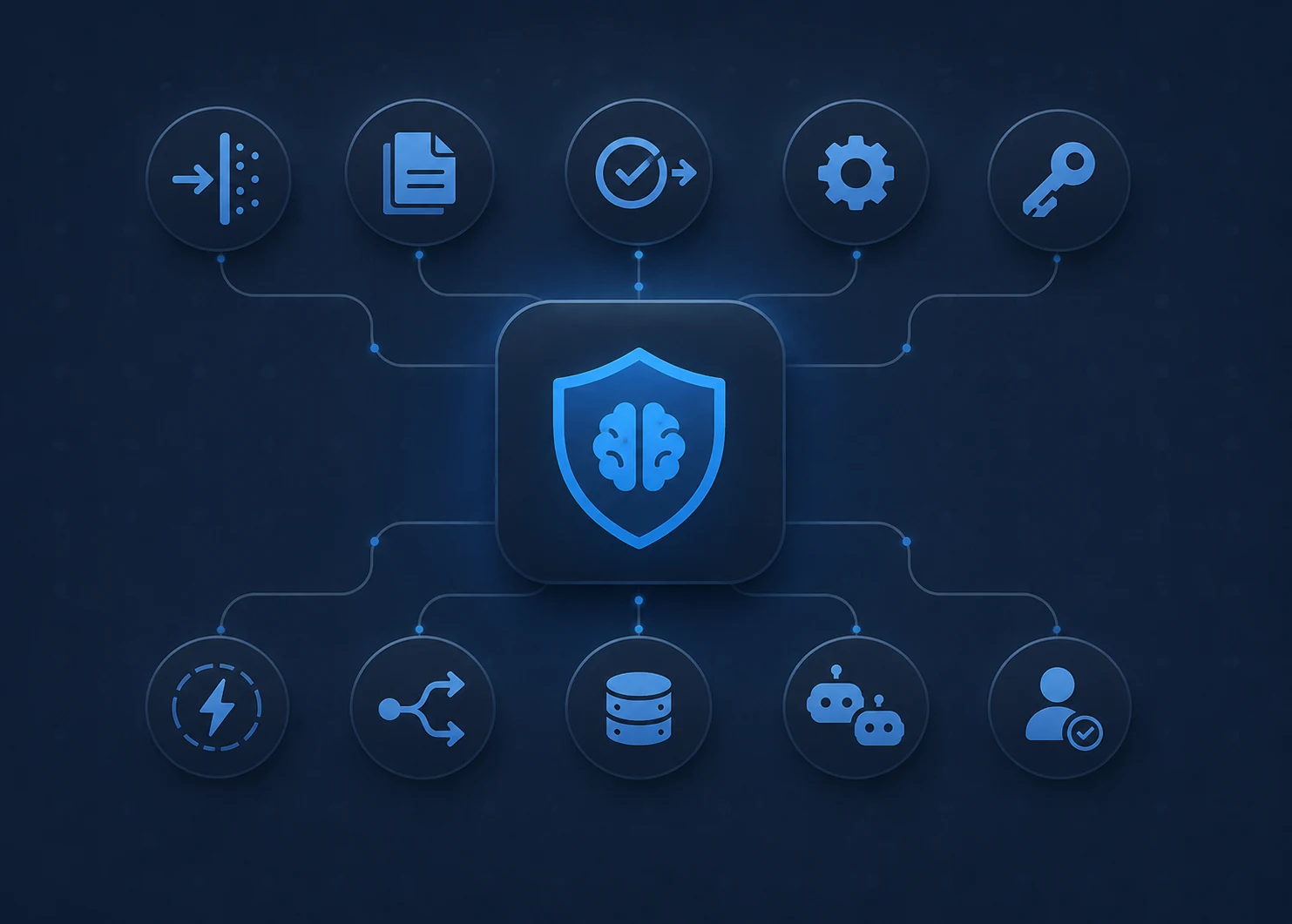
Input Guardrails
Control what enters the agent before any reasoning or tool use begins. Screen prompts, files, and user data for injection attempts, malicious links, and sensitive information.
Examples
- Prompt injection detection
- Input validation
- Sensitive-data detection
- File restrictions
- Malicious URL filtering
Context Guardrails
Control what information makes it into the model's working context. Filter, label, and validate context sources so the agent reasons over trusted, role-appropriate data.
Examples
- Context filtering
- Data redaction
- Role-specific context
- Trust labels
- Source validation
Output Guardrails
Check generated content before it leaves the system. Validate format, apply policy checks, and screen for PII, toxicity, or factual claims that don't hold up.
Examples
- Format validation
- Policy checks
- PII detection
- Toxicity checks
- Schema enforcement
Tool Guardrails
Control which tools an agent can call and validate how those tools are used once invoked. Enforce allowlists, check parameters, and apply rate limits.
Examples
- Tool allowlists
- Parameter validation
- Rate limits
- Environment restrictions
- Tool-specific rules
Permission Guardrails
Control what systems, data, and actions an agent is authorized to access. Apply role-based access and least-privilege scoping to every credential.
Examples
- Role-based access
- Least privilege
- Temporary credentials
- Read/write separation
- Resource-level permissions
Action Guardrails
Control what an agent can actually execute, independent of what a tool technically allows. Enforce transaction limits, approval requirements, and restrictions on destructive operations.
Examples
- Transaction limits
- Approval requirements
- Delete restrictions
- Publishing restrictions
- Deployment controls
Workflow Guardrails
Control the wider execution path across a multi-step task. Cap step counts, retry budgets, and timeouts, and insert required checkpoints.
Examples
- Step limits
- Retry budgets
- Timeouts
- Max delegation depth
- Required checkpoints
Memory Guardrails
Control what an agent is allowed to store and recall across sessions. Enforce retention limits, exclude sensitive data, and track provenance.
Examples
- Retention rules
- Sensitive-data exclusion
- Provenance tracking
- Memory validation
- User-specific boundaries
Multi-Agent Guardrails
Control how agents interact, delegate, and hand off work to one another. Validate delegation permissions and agent identity across every handoff.
Examples
- Delegation permissions
- Agent authentication
- Handoff validation
- Shared-state permissions
- Agent-to-agent rate limits
Human Approval Guardrails
Require a person to sign off before an agent proceeds with a specific class of action. Reserved for the highest-stakes decision points where autonomy cost outweighs convenience.
Examples
- High-value payments
- Contract changes
- Account deletion
- Public publishing
- Production deployment
AI Agent Guardrails Architecture
Guardrails aren't a single checkpoint — they're layered across the full path an agent's request travels, from the moment it enters the system to the moment its output reaches a user or another system.
↓
Input Guardrails — injection checks, validation, file/URL filtering
↓
Context + Permission Controls — filtering, role-based access, least privilege
↓
Agent / Model — reasoning, planning, tool selection
↓
Tool Guardrails — allowlists, parameter validation, rate limits
↓
Action Guardrails — transaction limits, approval requirements, delete restrictions
↓
Workflow Controls — step limits, retry budgets, timeouts, checkpoints
↓
Output Guardrails — format validation, PII checks, policy checks
↓
Monitoring / Evaluation — logging, anomaly detection, audit trail
AI Agent Guardrails for High-Risk Actions
Not every action an agent takes carries the same level of risk. A useful guardrail strategy classifies actions first, then matches the strength of the control to the actual consequences of getting that action wrong.
Classify Actions by Risk
Consider Reversibility
Reversibility is one of the clearest signals for how much control an action needs, since a mistake that can be undone is fundamentally less dangerous than one that can't. Updating a draft document or re-running a search costs almost nothing to reverse. Deleting a production database or sending an external email cannot be pulled back once it's happened, which pushes that action toward stricter, often human-gated control.
Consider Financial Impact
Financial impact scales the stakes of an action in a way that's easy to quantify. A refund of a few dollars and a wire transfer of six figures are technically similar actions but carry very different consequences if the agent gets them wrong. Action guardrails typically set transaction limits and approval thresholds that track this financial exposure directly.
Consider External Exposure
External exposure matters because an action visible outside the organization is much harder to quietly correct than one contained internally. A miscategorized internal ticket is a minor inconvenience, while a public social media post or a customer-facing email sent in error can damage trust immediately.
Consider Confidence
Confidence reflects how certain the agent's underlying model actually is about the decision behind an action. A high-confidence categorization task can often proceed automatically, while a low-confidence judgment call on an ambiguous request is a poor candidate for unsupervised execution.
Consider Novelty
Novelty describes how much a given situation resembles the patterns an agent has reliably handled before. A request that matches thousands of prior successful cases is a reasonable candidate for automation. A request that looks nothing like anything the system has handled is exactly the kind of edge case where a guardrail should slow the agent down rather than let it improvise.
AI Agent Guardrails for Multi-Agent Systems
Multi-agent systems introduce a control problem that single-agent architectures don't have to deal with. When one agent can delegate work to another, a restriction placed on the first agent means nothing if the second agent doesn't inherit or independently enforce that same restriction. Guardrails in multi-agent systems have to follow the task across every handoff, not just the agent that received the original request.
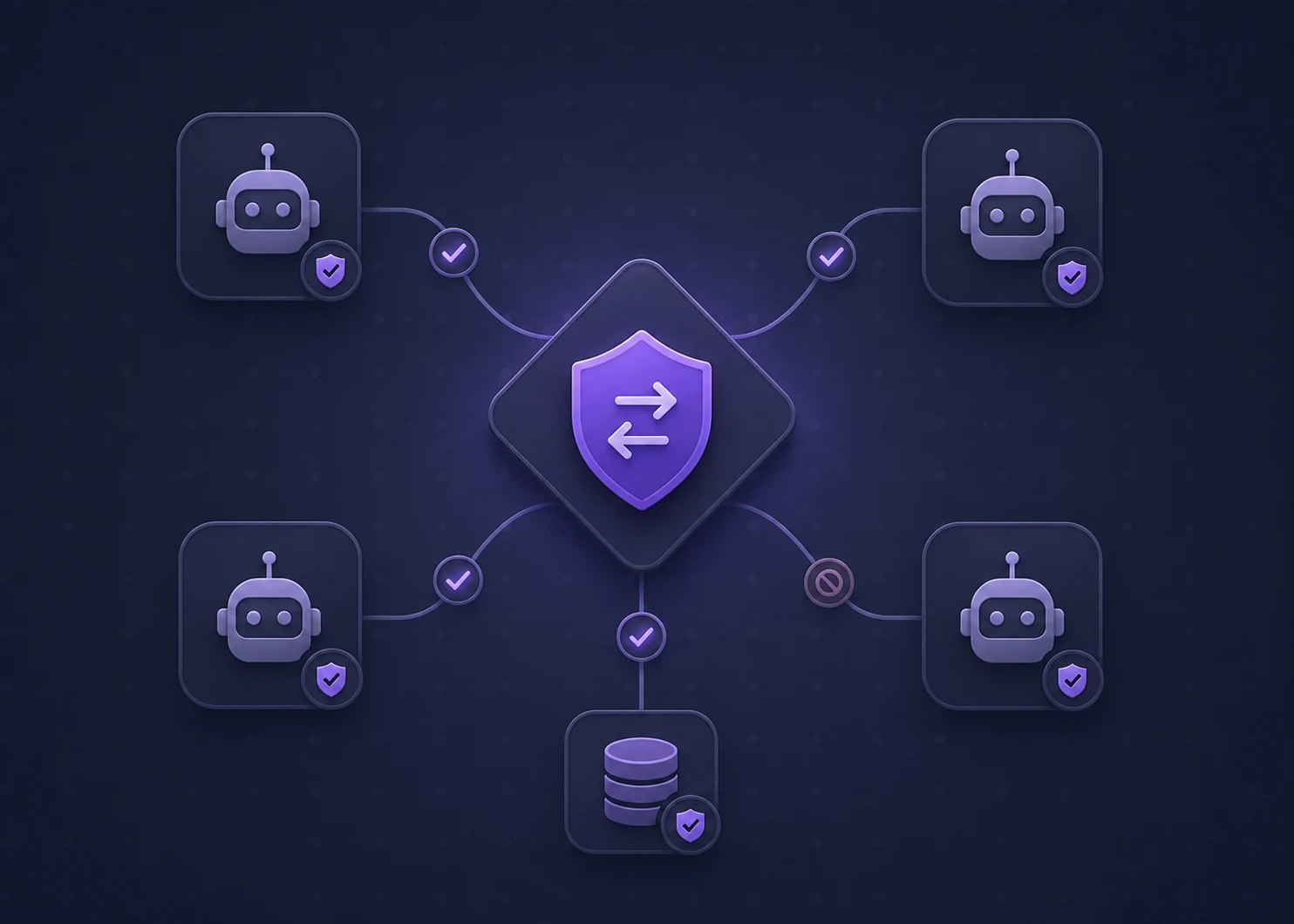
- Require every delegated task to carry its original permission scope so a handoff can't quietly grant broader access than intended.
- Authenticate each agent involved in a workflow individually, so no agent can act under another agent's identity or credentials.
- Validate every handoff before execution, checking that the receiving agent is authorized for the specific action being requested of it.
- Apply shared-state permissions so agents reading or writing common memory can't leak data outside their intended access boundaries.
- Set agent-to-agent rate limits to stop a delegation loop from generating far more actions than a human ever approved.
- Log delegation chains end to end, so a blocked action traces back to whichever agent first attempted it.
Common AI Agent Guardrail Failures
Guardrails don't fail because nobody wrote a policy — they fail because the policy wasn't enforced at the layer where it mattered. Understanding these failure patterns is what separates a guardrail that looks good on paper from one that actually holds up in production.
How Do You Balance Safety With Agent Autonomy?
Balancing safety with autonomy isn't about adding as many restrictions as possible and hoping the agent still gets useful work done. Over-restricted agents get abandoned by the teams that built them, because every routine task ends up stuck waiting on an approval it didn't need. The goal is controlled autonomy: enough freedom for an agent to be genuinely useful, with guardrails concentrated where the actual risk lives.
- Constrain only the actions that carry real financial, legal, or reputational risk, rather than applying the same restrictions everywhere.
- Let low-risk, reversible work like drafting, searching, and summarizing proceed automatically without routing it through unnecessary review steps.
- Use risk-based controls that scale approval requirements to the reversibility, cost, and external exposure of each specific action.
- Place human approval at meaningful decision points, not at every step, so reviewers focus on decisions that actually need judgment.
- Monitor agent behavior continuously so control levels can be adjusted as an agent's track record and context change over time.
- Avoid blocking legitimate work by regularly revisiting guardrails that trigger repeatedly on tasks that never actually needed restriction.
AI Agent Guardrails Best Practices
- Enforce permissions and action limits at the tool or execution layer, not just inside the prompt an agent receives.
- Classify actions by risk before deployment, and route only high-impact or irreversible actions through a human approval workflow.
- Validate every tool call's parameters against expected ranges, since an allowlisted tool can still be misused with unsafe inputs.
- Apply least privilege to every credential an agent holds, scoping access tightly to what the current task actually requires.
- Design workflow guardrails with step limits, retry budgets, and timeouts so a failure mode can't compound into a runaway process.
- Monitor and log guardrail behavior continuously, treating repeated overrides or bypasses as a signal to revisit the control itself.
Conclusion
- AI agent guardrails are enforceable controls, not prompt-level suggestions, and they work best when placed at the layer closest to the actual risk.
- Guardrails span input, context, model, tool, permission, action, workflow, output, and monitoring layers — and most systems need several working together.
- Guardrails and governance are related but distinct: guardrails enforce, governance decides what should be enforced and who's accountable for it.
- Autonomous agents need stronger controls than text-only systems because they can create side effects, compound errors, and act on untrusted information.
- Risk-based classification — weighing reversibility, financial impact, external exposure, confidence, and novelty — should determine how much control an action needs.
- Multi-agent systems require their own guardrails so a blocked action can't become executable simply by delegating it to another agent.
- The goal is controlled autonomy: strong enough guardrails to contain real risk, without blocking the low-risk work agents are built to handle.
Frequently Asked Questions
What are the main types of AI guardrails?
The main guardrail types are input, context, output, tool, permission, action, workflow, memory, multi-agent, and human approval controls enforced during execution. Most production agent systems combine several of these types rather than relying on just one.
What is the difference between guardrails and governance?
Guardrails are the specific technical controls enforced during an agent's execution, while governance is the broader policy and oversight framework. Governance defines the rules an organization wants; guardrails are what actually enforces them in real time.
Are prompt guardrails enough for AI agents?
Prompt guardrails alone are not enough for AI agents, because a prompt is an instruction the model can misinterpret or ignore. Reliable protection requires enforcement closer to the tools, permissions, and actions the agent can actually use.
Where should AI guardrails be implemented?
AI guardrails should be implemented at every layer where risk can occur, from input and context to tools and output. Concentrating controls in only one layer leaves every other layer open to bypass.
How do tool guardrails work?
Tool guardrails work by restricting which tools an agent can call and validating the parameters passed to each one at runtime. They typically combine allowlists, rate limits, and environment restrictions so a tool can't be invoked outside its intended scope.
How do you prevent an AI agent from taking unauthorized actions?
Preventing unauthorized actions requires permission guardrails scoped to least privilege, paired with action-layer controls enforced at the moment of execution. Prompt-level warnings alone can't stop an action that the agent's credentials still technically allow it to take.
Which AI agent actions should require human approval?
High-value payments, contract changes, account deletion, public publishing, and production deployment typically require human approval. These actions are costly, hard to reverse, or externally visible, so lower-risk actions can proceed without that step.
What are guardrails for multi-agent systems?
Guardrails for multi-agent systems govern how agents delegate tasks, authenticate one another, and validate handoffs between separate cooperating agents at runtime. They also cover shared-state permissions and rate limits so delegation can't quietly bypass an existing restriction.