
What Are Enterprise AI Agents?
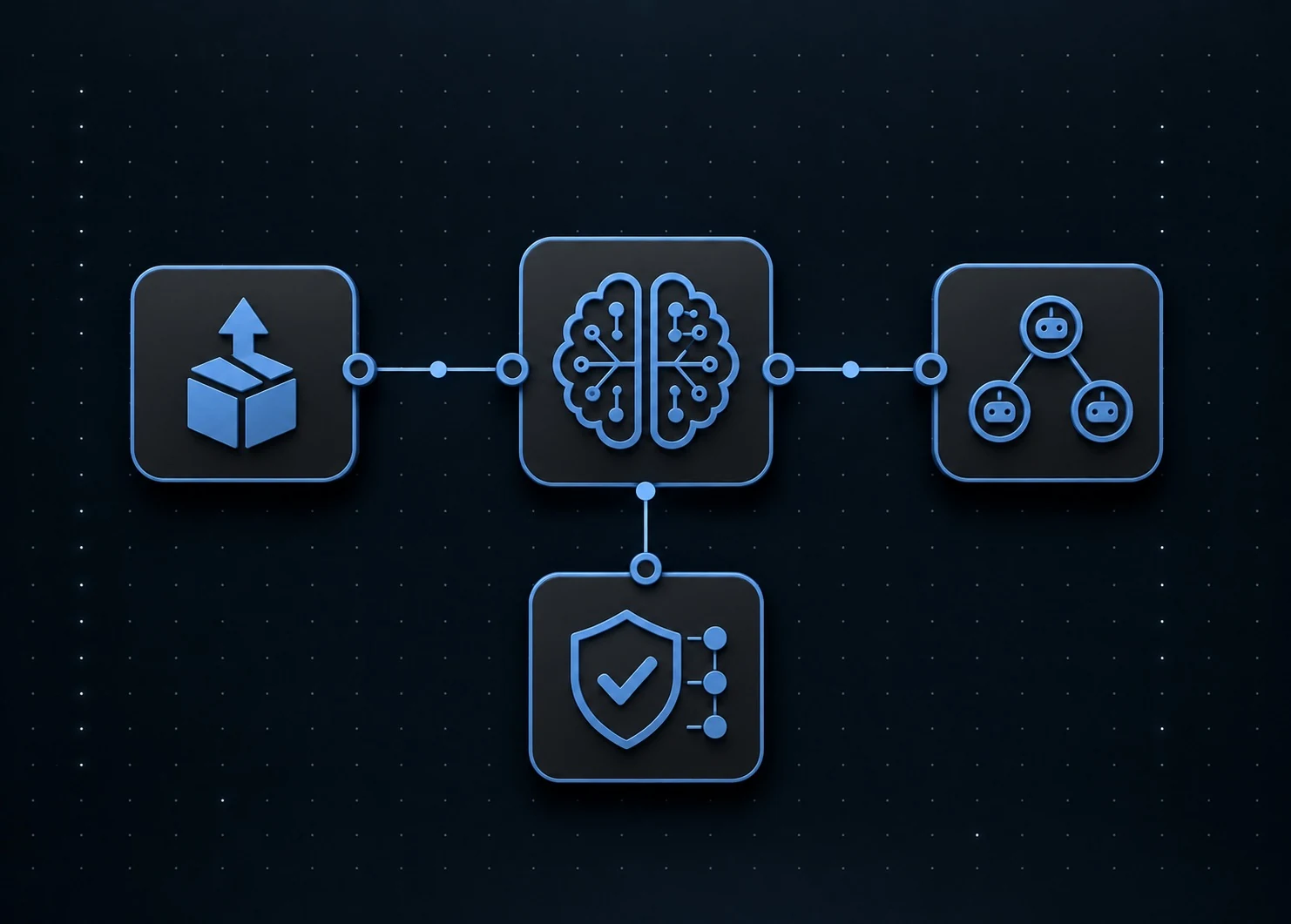
An enterprise AI agent is a software system that combines a language model with business data and tools to act independently. Rather than waiting for a single prompt and returning a single answer, it holds instructions, permissions, and memory across a task that might touch several systems. Underneath the model sits the part most vendors don't talk about: execution logic, monitoring, and the plumbing that lets the agent actually reach enterprise systems safely.
Every enterprise AI agent, regardless of what it's built for, is made up of the same basic parts.
- An AI model that handles reasoning and language
- Instructions and business context that define its role
- Access to enterprise data sources
- Tools and integrations it's allowed to call
- Permissions that define what it can touch
- Memory to track state across a task
- Execution logic that sequences its actions
- Monitoring that records what it did and why
None of these pieces do much by themselves; a model without permissions can't do anything useful, and permissions without a model are just an access list. It's the combination, wired together deliberately, that turns a language model into something that can run part of a business process.
A chatbot or copilot is built to help a person do their job faster; it drafts, summarizes, and answers, then stops and waits for the next question. An enterprise AI agent is built to carry a task through to completion, which means it needs the authority, within defined limits, to actually do things rather than just suggest them. That distinction, more than any specific feature, is what separates an agent from the assistant most employees are already using.
Enterprise AI Agents vs AI Assistants
An AI assistant is reactive by design. You ask, it answers, and the interaction ends there - even a very capable assistant won't update a record or notify a team unless you tell it to, every time. An enterprise AI agent works from a goal rather than a single prompt, which means it can plan a sequence of steps, call APIs, query databases, act inside SaaS platforms, and in more advanced setups, hand off work to other agents.
Enterprise AI Agents vs Traditional Automation
Traditional automation, the RPA scripts and workflow engines many enterprises already run, follows a fixed path. If a form field is empty or a system returns an unexpected response, the automation usually breaks and needs a person to fix it. Agents built on AI models can interpret context, weigh which action fits the situation, and adjust the workflow when conditions change, without someone rewriting the logic every time an edge case appears.
What Makes an AI Agent Enterprise-Ready?
A capable model is table stakes, not the finish line. An agent is enterprise-ready when it has a verifiable identity, permissions scoped to what its job actually requires, governance controls that apply before and after it acts, and enough reliability that it behaves the same way under load as it does in a demo. Observability and auditability matter just as much - teams need to see what an agent did and reconstruct why, and integration controls determine whether it can reach a system safely or whether it becomes a new attack surface.
How Enterprise AI Agents Work
Enterprise AI agents work by moving a request through a defined chain of layers: goal interpretation, context retrieval, reasoning, tool use, action, and monitoring. Each layer exists to answer one question: what is being asked, what does the agent need to know, what should it do, and can it be trusted to do it?
Goal and Instruction Layer
This is where a request (from a person, a system trigger, or another agent) gets translated into a concrete objective the agent can work against. The layer also carries the agent's standing instructions: its role, its boundaries, and the business rules it's expected to follow regardless of what's being asked. Without a clear goal layer, an agent tends to improvise in ways that are hard to predict or reproduce.
Context and Knowledge Layer
Before an agent can act, it needs to know what's actually true in the business right now, not just what it was trained on. This layer pulls in relevant data (customer records, policy documents, recent transactions) usually through retrieval or direct system queries. The quality of this layer has an outsized effect on the agent's output, since a well-reasoned decision built on stale or incomplete data is still a bad decision.
Reasoning and Decision Layer
Here the model interprets the goal and the retrieved context and decides on a course of action, weighing options the way a person would triage a task. This is also where an agent decides whether it has enough information to proceed or needs to ask a clarifying question. In more complex agents, this layer may break a large goal into smaller sub-tasks and sequence them.
Tool and Integration Layer
Once a course of action is chosen, the agent needs a way to actually carry it out, which is where tools and integrations come in. This layer connects the agent to APIs, internal systems, and third-party platforms, translating a decision like "update the shipping address" into an actual system call. It's also the layer where most security exposure lives, since every tool the agent can call is a door into a production system.
Action and Approval Layer
This is where the agent executes - or, for higher-risk actions, where it stops and routes the decision to a human for approval first. Not every action needs the same level of oversight; a low-risk lookup can run automatically while a refund over a certain amount waits for sign-off. Getting this threshold right is one of the more consequential design decisions in the whole system: set it too low and people become a bottleneck, set it too high and mistakes reach production.
Monitoring and Audit Layer
Every action an agent takes, along with the reasoning that led to it, gets logged here so the sequence can be reviewed later. This layer is what makes an agent's behavior explainable after the fact, rather than a black box that either worked or didn't. It also feeds back into governance, since patterns in the logs are usually how teams catch permission creep or a misbehaving agent before it causes real damage.
Enterprise AI Agents Deployment Models
Different enterprise agents require different levels of infrastructure to be successful, and the ability to match the model of deployment to the workflow process at that organization is much more important than selecting the most advanced agent available. Below is a chart that explains five patterns ranging from simple agent operation to completely hybrid setup suitable in regulated environments.
Single-Agent Deployment
In the single-agent model, only one type of task is performed, such as answering one group of support tickets, checking order status, or summarizing a certain type of report. It is easy to implement and maintain, which is why most companies begin using this type of system even if they plan to enhance it later. The only drawback is that it is not easy to extend a single agent's capabilities beyond a specific set of tasks.
Tool-Connected Enterprise Agents
A tool-connected agent is an extension of a single-agent model, providing access to some business tools, a CRM, and a ticketing system, among others, so the agent can take action based on the information it finds. In most cases, it is at this stage that departments, rather than individual use cases, initiate their agency standardization process. It introduces more surface area for governance to cover, since every added tool is another thing the agent could misuse if permissions aren't scoped tightly.
Multi-Agent Systems
A multi-agent system splits a complex process into specialized agents that each handle one part and pass work to the next, similar to how a sales deal moves through people on a team. A common pattern looks like this:
With each agent narrowly scoped to its own step. The hard part isn't building the individual agents; it's the coordination and orchestration layer that decides which agent acts when, and what happens if one of them fails partway through.
Centralized Enterprise Agent Platforms
Centralized platforms treat agents as resources administered across the organization rather than developing agents separately for each team, while unifying identity, logging, and tool access for all agents regardless of their creators. It requires significant upfront investment, but it enables hundreds of agents while avoiding the need for each team to reinvent management processes. Organizations with tight governance regulations often combine this with elements of a hybrid structure to organize sensitive business processes.
How to Deploy Enterprise AI Agents
Deploying enterprise AI agents means guiding them through predetermined stages, such as planning, development, testing, and approval, before production.
- Stage 1: Identify the Use Case and Scope: Start by choosing a specific, concrete use case, since broadly defined scope tends to slow implementation of agent-based initiatives.
- Stage 2: Attribute Identity and Permissions: Equip the agent with its own credentials and the minimum permission level needed to perform the assigned tasks; avoid sharing any accesses associated with human accounts.
- Stage 3: Link Tools and Data Sources: Connect only the systems necessary to carry out the task, as new connections create additional opportunities for failure.
- Stage 4: Test the Agent Using Real and Edge-Case Scenarios: Put the agent through its paces using actual requests and edge-case situations before the wider project audience sees it.
- Stage 5: Escalate Critical Actions for Approval: Pre-establish the rules and thresholds regarding cases that require human approval depending on the financial repercussions of the intervention, the possibility of remediation, and the extent of regulatory risk involved.
- Stage 6: Deploy in Controlled Environments: Transfer the agent from the sandbox to pilot production and later to a full-scale deployment while conducting close monitoring.
- Step 7: Monitor, Audit, and Iterate: Track what the agent actually does in production and adjust its scope, tools, or instructions as real usage reveals gaps.
Enterprise AI Agent Governance
Governance is the part of enterprise AI agent programs that gets skipped early and becomes urgent later, usually right after an agent does something nobody expected. It's tempting to treat governance as a content problem, making sure an agent doesn't say something wrong, but that framing misses most of the actual risk. The real exposure lies in what an agent can access, decide, execute, and change inside real business systems, not just what it generates in a chat window.
Agent governance is not only about controlling AI outputs. It must control what agents can access, decide, execute, and change. That means treating each agent less like a chatbot with a content filter and more like a system account with its own identity, audit trail, and owner who is accountable when something goes wrong.
Agent Identity
Every agent needs its own identity, a distinct credential, not a shared service account or someone's personal login repurposed for convenience. Without a unique identity, there's no reliable way to answer a basic question after the fact: which agent did this, and under whose authority? Enterprises that skip this step often learn why it mattered during an incident review, when logs show an action but can't tie it to a specific agent, version, or owner.
Role-Based Permissions
Permissions should follow the same least-privilege principle enterprises already apply to human accounts: an agent gets access to exactly what its role requires and nothing else. A research agent that only needs to read records shouldn't have write access to a production database, even if it would technically make some future task easier. Scoping permissions tightly at the start is far less painful than trying to claw back access after an agent has been running for months with broader rights than it needed.
Human Approval Workflows
Not every action an agent takes carries the same risk, so approval workflows shouldn't treat them all the same way either. Low-stakes, reversible actions can run without a human in the loop, while anything involving money, contracts, or customer-facing changes typically needs a person to sign off before it executes. The design challenge is calibration: thresholds set too conservatively turn the agent back into a suggestion engine, while thresholds set too loosely defeat the purpose of having approval workflows at all.
AI Agent Audit Trails
An audit trail records what an agent did, what data it used, what decision it reached, and why, in enough detail that someone can reconstruct the sequence months later without guessing. This matters for troubleshooting, but it matters just as much for compliance, since regulators and internal auditors increasingly expect the same traceability from an agent's actions that they'd expect from a human employee's. Agents without meaningful audit trails are difficult to trust with anything beyond low-stakes, easily reversible work.
Version Control
Agents change over time - prompts get refined, tools get added, models get swapped - and each of those changes can shift behavior in ways that aren't obvious until something breaks. Version control means tracking those changes deliberately, so a team can identify exactly what changed if an agent starts behaving differently, and roll back if needed. Treating agent configuration with the same discipline as application code, rather than as something edited freely in a prompt window, prevents a lot of avoidable incidents.
Policy Enforcement
Policies define the rules an agent has to operate within (data handling requirements, industry regulations, internal business rules), and enforcement is what makes those rules apply automatically rather than depending on the agent interpreting them correctly every time. Strong policy enforcement sits outside the model itself, in the permission layer and the approval workflow, so a rule holds even if the model's reasoning drifts. This is one of the clearer arguments for centralized governance over letting each team manage its own agents independently.
Agent Ownership
Every agent needs a named owner, someone accountable for what it does, responsible for reviewing its performance, and positioned to shut it down if something goes wrong. Ownership tends to get fuzzy in practice, especially for agents built by one team but used across several departments, which is exactly the kind of ambiguity that governance programs need to close early. An unowned agent, functionally, is an unmonitored one, regardless of how well it was built initially.
Scaling Enterprise AI Agents Across the Organization
Scaling from one working agent to dozens or hundreds isn't a matter of running the same setup more times. The challenges that show up at scale are different in kind, not just in volume, from the ones a single pilot project runs into. A pattern that worked cleanly for one department's agent can create real problems once several departments are running similar agents with no shared oversight.
Agent scalability involves organizational, technical, governance, and operational scalability, and treating it as purely a model-capacity question misses most of what actually breaks. Technical scalability covers whether the infrastructure can handle agent volume and the tool calls that come with it, while organizational scalability covers whether teams even agree on how agents should be built and managed. Governance and operational scalability, meanwhile, determine whether anyone can still answer basic questions, what's running, who owns it, what can it touch, once the number of agents climbs into the hundreds.
None of this shows up as a crisis in a pilot; a single well-scoped agent is manageable almost regardless of how it was built. The cracks appear later, usually once several teams have each built their own version of a similar agent with different permissions, different logging, and no shared registry of what exists. The sections below cover the practical steps that keep that from happening.
Standardize Agent Architecture
When every team builds agents its own way, the organization ends up maintaining several incompatible systems instead of one that scales. A shared architecture, common patterns for identity, tool access, logging, and approval, lets teams build faster because they're not solving the same infrastructure problems repeatedly. It also makes agents easier to govern, since a consistent structure is easier to audit than a dozen bespoke ones.
Build Shared Tool Infrastructure
If three teams each build their own connection to the same CRM, that's three integrations to secure, maintain, and eventually fix when the API changes. A shared tool layer, a set of vetted, reusable connections that any approved agent can call, cuts that duplication down to one integration used many times. It also gives security teams a single place to enforce access controls, instead of chasing down integrations scattered across the organization.
Centralize Agent Management
As the number of agents grows, someone needs a single view of what exists, who owns it, what it can access, and whether it's still in use. Centralized management doesn't mean every agent is built by one team; it means every agent is registered, tracked, and governed through the same system regardless of who built it. Without that central view, agent sprawl becomes very difficult to notice until it's already a problem.
Design for Multi-Agent Collaboration
Agents that will eventually need to work together should be designed with that in mind from the start, rather than retrofitted later. That means defining how agents hand off tasks, what format they exchange information in, and what happens if one agent in a chain fails partway through its part of the work. Skipping this at the design stage tends to mean rebuilding the coordination logic later, under more pressure and with more agents already depending on it.
Separate Agent Logic From Business Policy
An agent's reasoning logic, how it interprets a request and decides what to do, should be kept separate from the business policies that constrain it, like spending limits or approval thresholds. When those two things are tangled together, updating a policy means touching the agent's core logic, which is slower and riskier than it needs to be. Keeping policy in a layer the agent reads from, rather than hardcoded into its instructions, makes it possible to update the rules without redeploying the agent itself.
Control Model and Infrastructure Costs
Agent activity scales with usage, and usage tends to grow faster than most teams expect once an agent proves useful. Costs climb quickly if every task routes to the most capable, and most expensive, model available, regardless of whether the task actually needs that level of reasoning. Intelligent routing, where simpler tasks go to smaller or cheaper models and only complex reasoning goes to the larger ones, keeps costs proportional to what each task actually requires.
AI Agent Orchestration at Enterprise Scale
Orchestration is the layer that decides which agent handles which part of a task, in what order, and what happens when something in the chain doesn't go as expected. As the number of agents in an organization grows, orchestration stops being optional and becomes the thing that determines whether the whole system holds together.
↓
Orchestrator Agent
↓
Specialized Agents
Research | Finance | Operations
↓
Approval Layer
↓
Enterprise Systems
↓
Audit + Monitoring
Centralized Orchestration
In a centralized model, one orchestrator agent determines which agents handle specific tasks and in what sequence. It keeps coordination logic in a single, inspectable place, which makes the overall system easier to reason about and to debug when something goes wrong. The tradeoff is that the orchestrator itself becomes a critical dependency; if it's misconfigured or goes down, everything routed through it stalls.
Decentralized Agent Collaboration
In a decentralized model, agents communicate directly with each other based on predefined relationships, without a single orchestrator sitting in the middle of every interaction. This can be more resilient, since there's no single point of failure, and it scales naturally as new agent-to-agent relationships get added. It's also harder to govern, since tracking a decision across several agents talking directly to each other takes more deliberate audit design than following a single orchestrator's log.
Hierarchical Agent Systems
A hierarchical system uses parent or manager agents to supervise specialized worker agents beneath them, similar to how a manager delegates tasks to a team and reviews the output. This architecture can mirror real organizational structures, which makes it intuitive for business stakeholders to understand even without a technical background. It also concentrates accountability at the manager-agent level, which can simplify oversight compared to a fully decentralized system.
Event-Driven Agent Workflows
Agents activate when business events occur (for example: a new lead comes in, a payment fails, a support ticket escalates, a contract nears renewal, or inventory drops below a threshold), rather than running on a fixed schedule or waiting for a direct request. This model fits processes that are inherently reactive, where the value comes from responding quickly rather than on a predictable cadence. It does require reliable event infrastructure underneath it, since an agent that never receives the trigger never acts on it.
Enterprise AI Agent Lifecycle Management
Most of the risk in an enterprise agent program doesn't come from any single bad decision the agent makes; it comes from agents that outlive their usefulness and keep running anyway. Managing the full lifecycle, from creation through retirement, is what separates a mature agent program from a collection of tools nobody's fully tracking.
Agent Creation
Creating an agent means defining its responsibilities, the tools and data it needs, the model it will run on, and how success will be measured before it ever handles a real task.
Testing
Testing should cover both expected and unexpected scenarios before production, since the situations an agent handles poorly are rarely the ones anyone thought to plan for.
Approval
Before deployment, an agent should go through security or compliance review appropriate to what it can access and what it's authorized to do.
Deployment
Agents should move through controlled environments such as sandbox, limited production, full rollout, rather than going live everywhere at once.
Monitoring
Ongoing monitoring tracks both agent behavior and the business outcomes it's producing, since technically correct behavior doesn't always translate into a good result.
Updating
Updates need version tracking for prompts, tools, models, and workflows, since even a small change to any of these can shift how an agent behaves.
Retirement
Retiring an agent means removing it from active use and revoking its permissions and credentials, not just letting it sit unused. Inactive agents that still hold access are a real security liability, since forgotten credentials are exactly the kind of thing that gets exploited quietly, long after anyone remembers the agent exists.
Common Enterprise AI Agent Scalability Challenges
As agent programs grow, the same handful of problems tend to show up across most organizations, regardless of industry.
The Future of Enterprise AI Agents
The direction most enterprise AI programs are heading isn't toward a single, more powerful agent handling everything, but toward governed networks of specialized agents working within defined boundaries. Each agent stays narrow and well-scoped; what changes is how many of them exist and how tightly their interactions are managed.
Enterprise software itself may increasingly become the execution layer underneath AI agents, rather than the primary interface employees interact with directly. Instead of a person logging into five systems to complete a process, an agent moves through those same systems on the person's behalf, with the software doing the execution while the agent does the coordinating.
Competitive advantage in this shift will not come from simply having more agents deployed than a competitor. It will come from coordinating agents safely across real business operations, in a way that holds up under audit and doesn't fall apart the first time something goes wrong.
- Specialized agents will increasingly hand off work to each other automatically, coordinated through orchestration rather than manual scheduling.
- Governance will shift from a compliance afterthought into a design requirement built into agents from their very first deployment.
- Enterprise software vendors will likely expose more of their functionality through APIs built specifically for agents to call directly.
- Central agent registries will become standard practice, the same way identity and access management became standard for human accounts.
- Model routing will grow more sophisticated, sending simple tasks to cheaper models and complex reasoning to larger ones automatically.
- Audit and monitoring tooling built for agents will mature into something closer to standard enterprise infrastructure than a specialty add-on.
- Organizations that treat agent governance as foundational, rather than reactive, will likely scale further with fewer costly incidents.
Final Words
- Enterprise AI agents extend far beyond chat-based assistants, combining models, data access, tools, and permissions into systems that can execute real work.
- Deployment succeeds when it moves through defined stages: scoping, building, testing, approval, and monitoring.
- Governance has to control what agents can access, decide, execute, and change, not just what they generate.
- Scaling agents is an organizational and governance challenge as much as a technical one.
- Orchestration determines whether specialized agents work together reliably or create conflicts across shared systems.
- Lifecycle management, especially retirement, closes the gap where unused agents quietly become security liabilities.
- The organizations that get the most value from agents will be the ones that treat governance as part of the architecture, not an afterthought.
Frequently Asked Questions About Enterprise AI Agents
What is an enterprise AI agent?
An enterprise AI agent is a software system that combines an AI model with business context, data access, permissions, and tools. It can complete multi-step tasks inside real business systems, rather than just responding to a single question.
How are enterprise AI agents different from chatbots?
Chatbots and copilots respond to a prompt and stop; enterprise AI agents work from a goal, and can take a sequence of actions across systems. They need permissions, approval workflows, and audit trails that a simple chatbot doesn't.
How do enterprises deploy AI agents?
Enterprises deploy AI agents by scoping a narrow use case, assigning the agent its own identity and permissions, connecting only the tools it needs, testing against real and edge-case scenarios, and rolling out through controlled environments before full production use.
How do you govern enterprise AI agents?
Governing enterprise AI agents means controlling identity, permissions, approval workflows, audit trails, version control, and policy enforcement. Each agent is treated like an accountable system account rather than just monitoring what it says.
Can enterprise AI agents work together?
Yes. Multi-agent systems split a process into specialized agents that hand off work to one another, coordinated through an orchestration layer that decides which agent acts when and how failures in the chain are handled.
How do you scale AI agents across an enterprise?
Scaling agents involves standardizing architecture, building shared tool infrastructure, centralizing agent management, designing for multi-agent collaboration, separating agent logic from business policy, and controlling model and infrastructure costs as usage grows.
What is the difference between enterprise AI agents and agentic AI?
Agentic AI refers to the broader capability of AI systems to pursue goals and take autonomous action. Enterprise AI agents are a specific, production-grade application of that capability, built with the identity, permissions, governance, and infrastructure required to operate safely inside a real organization.