
Every vendor now says "agentic," and most operators have heard the word without getting a clear definition. This guide explains agentic AI in plain business terms. It shows how it differs from chatbots, copilots and rule-based automation, and gives you a way to judge whether your own work is ready for it.
If you run operations, marketing or sales at a growing company, you have probably sat through a demo where an "AI agent" did something impressive. You may also have wondered what was real and what was a chatbot with a new label. That doubt is reasonable. The term covers a real shift in how software handles work, and it also attracts a lot of loose marketing.
The short version: agentic AI is software that is given a goal, works out the steps, uses your tools to carry them out, and brings a person in when a decision needs one. The rest of this article unpacks that sentence and shows where it fits, and where it does not.
Key takeaways
- Agentic AI pursues a goal across multiple steps. It does not just answer one prompt at a time.
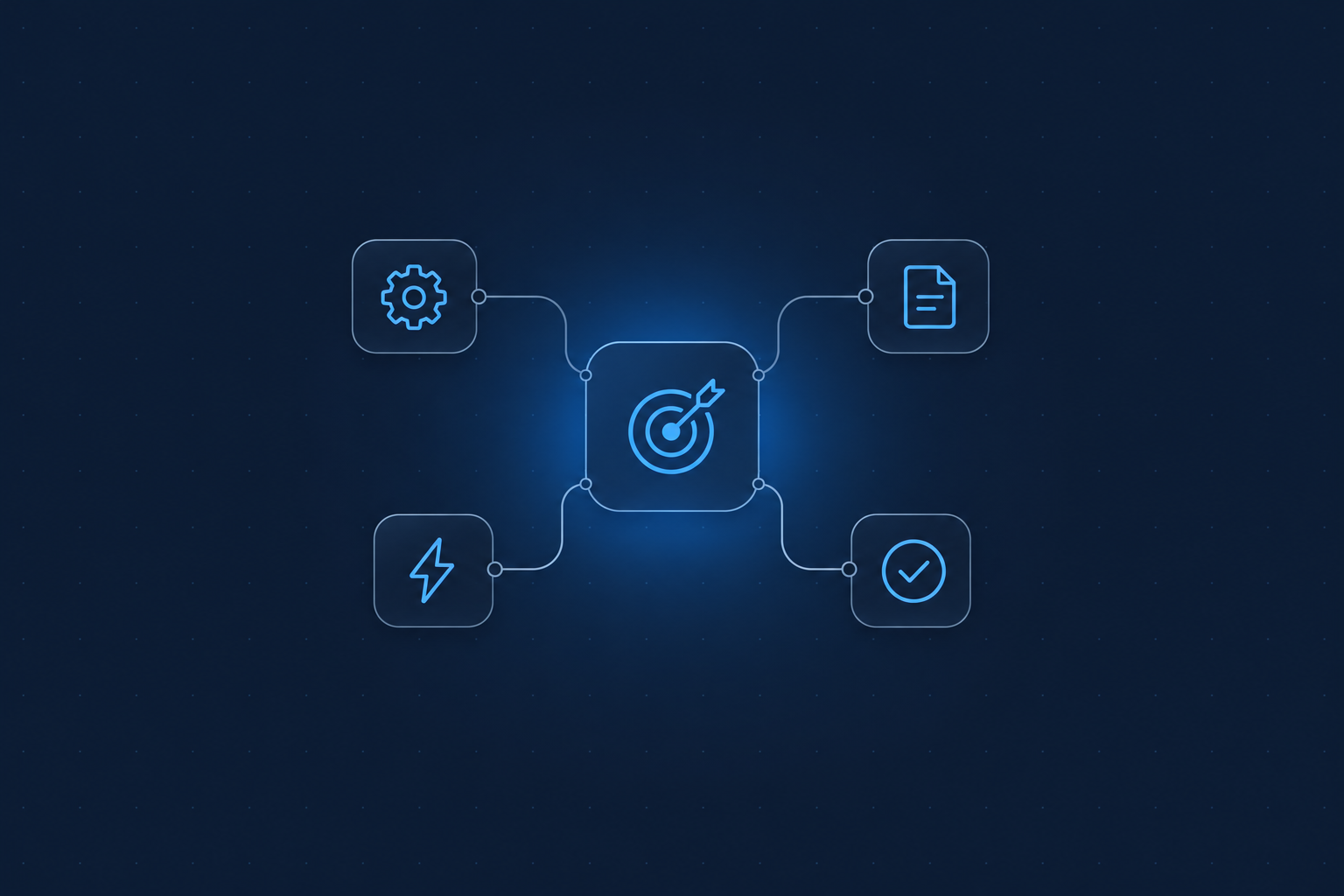
- Four traits make a system agentic: it works toward a goal, plans steps, uses tools, and hands off to a human at defined points.
- Chatbots answer, copilots assist a person, RPA follows fixed rules, and agents carry a task through to an outcome.
- Human approval is a design choice you set per task, based on the cost of a mistake.
- Work is ready for agents when it is repeated, reachable through your systems, clearly defined, and owned by someone who can approve it.
What is agentic AI?
Agentic AI describes AI systems that act toward a goal with some independence. You give the system an outcome, such as "follow up with every new inbound lead within the hour." The system then decides what to do first, does it, checks the result, and continues until the goal is met or it needs help.
The word "agentic" points at agency: the ability to take a series of actions without being told each one. Most of the AI tools people used in 2023 and 2024 worked one prompt at a time. You asked, they answered, and you decided what to do with the answer. An agentic system takes on the doing as well.
That does not mean it works without oversight. In a well-built system, the agent has limits on what it can touch, a record of everything it does, and clear points where it stops and asks a person. We come back to that below.
How agentic AI differs from chatbots, copilots and RPA
The easiest way to understand agentic AI is to set it next to the tools you already use.
Chatbots
A chatbot is built for conversation. It responds, then waits. It is useful for answering common questions, but it does not usually go and change anything in your systems.
Copilots
A copilot sits beside a person and speeds up their work. It drafts, summarizes and suggests. The person still starts each task and finishes it. This is valuable, but the human remains the engine.
RPA and rule-based automation
Robotic process automation and tools built on "if this, then that" rules are dependable when inputs are clean and predictable. They struggle when something changes: a supplier sends an order in a new format, or a form field is blank. The script either fails or does the wrong thing. Agentic systems are designed for the cases where judgment or interpretation is needed. Put simply: automation follows rules, while an agent can handle the exception and ask when it should.
Rules are not obsolete. For a stable, high-volume task with clean inputs, a simple rule-based automation is often cheaper and easier to audit. Agents earn their place where the work is messy.
Four traits that make a system agentic
A tool can use a large language model and still not be agentic. Four traits separate the two.
1. It pursues a goal
An agentic system is handed an outcome, not a single instruction. "Draft a reply" is a task. "Make sure every inbound lead is qualified and followed up" is a goal. The system keeps working until the goal is met or it is blocked.
2. It plans multiple steps
To reach a goal, the system breaks the work into steps and decides the order. If a step fails or returns something unexpected, it adjusts rather than stopping dead. This is the biggest practical difference from a fixed script.
3. It uses tools
An agent is only useful if it can act. That means connecting to the systems your team already uses: your CRM, inbox, help desk, spreadsheet, database or a web portal. Without tools, you have an advisor. With tools, you have something that can do the work, which is also why access limits matter.
4. It hands off to a human at escalation points
A good agent knows what it should not decide alone. It stops and passes the work to a person when the situation is unclear, when the stakes are high, or when a rule says it must. This trait is what makes agentic AI safe enough to use on real work.
If a product is missing one of these four, it may still be useful. It is just not agentic in the sense that matters for operations.
Concrete examples from marketing, sales and operations
Abstract definitions only go so far. Here is how the four traits show up in everyday B2B work.
Marketing: from topic to draft
Goal: publish a useful blog post each week. An agent proposes topics from keyword data, writes a brief, drafts the article, checks it against your brand guidelines, and queues it for review. A person approves the topic and the final draft before anything goes live. The agent handles production, and your team keeps direction and positioning. Reporting Hub's blog, newsletter and founder LinkedIn posts come from its Marketing department on Harnyss. See how this looks in practice on the Harnyss marketing department page.
Sales: from inbound lead to follow-up
Goal: every inbound lead gets a timely, relevant reply. An agent reads the form submission, looks up the company, scores fit against your criteria, updates the CRM and drafts a personalized email. A seller approves the email before it is sent under their name. The agent handles the admin work so the seller spends more time talking to buyers. Harnyss uses this pattern for its own CRM enrichment and personalized email. More on this in the revenue department overview.
Operations: from emailed order to system entry
Goal: orders that arrive by email end up correctly in the order system. An agent reads the message, extracts the details, checks them against the customer record, and enters the order. When an order is unclear or falls outside the rules, the agent does not guess. It sends the order to a person with a note on what is missing. See the operations department page for more examples.
In all three cases, the pattern is the same: a goal, a plan, tool use, and a defined point where a human steps in.
Where human approval fits in
The most common worry we hear from operators is some version of "Will it send something to a customer without asking me?" The honest answer is that it depends on how you set it up, and you should decide that deliberately.
Think of approval as a dial with three common positions:
- Requires approval. Nothing goes out until a person signs off. Use this for customer messages, contracts, pricing or anything that moves money.
- Notify only. The agent acts, then tells you what it did. Use this for moderate-risk work where you want visibility but not a bottleneck.
- Autonomous. The agent acts and logs everything. Use this for high-volume, low-stakes work such as tagging records or updating internal status fields.
A useful rule of thumb: the more expensive or hard to reverse a mistake is, the closer the task should sit to "requires approval." Start strict and loosen only once you have watched the agent's output over time.
Approval is not a sign the technology is weak. It is how you keep accountability with a named person while the agent absorbs the repetitive work. Good systems also check their own output before it reaches you, and hold back work that does not meet a quality bar. They keep a full log of what was done, when and why, so any action can be traced.
What the data says about agentic AI right now
Interest is high, and results are mixed. Two sources help keep expectations realistic.
According to McKinsey's 2025 State of AI survey, 62 percent of respondents say their organizations are at least experimenting with AI agents, and 23 percent report scaling an agentic AI system somewhere in their enterprise. The same survey found that in any given business function, no more than 10 percent of respondents say their organizations are scaling AI agents.
Gartner is more cautious. In June 2025 it predicted that over 40 percent of agentic AI projects will be canceled by the end of 2027, citing escalating costs, unclear business value or inadequate risk controls. Gartner also warned about "agent washing," where vendors rebrand existing assistants, RPA and chatbots without adding real agentic capability.
The takeaway for an operator is practical. Plenty of companies are trying agents, far fewer have made them part of daily work, and the projects that stall tend to lack a clear business case or clear controls. Both are things you can fix before you start.
How to tell whether your work is ready for agents
You do not need to transform the company to begin. You need one process that fits. Use these questions to test a candidate.
Is the work repeated?
Agents pay off on work that happens every week, not once a year. If a person spends hours on the same pattern of steps, it is a candidate.
Can the systems be reached?
The agent needs a way in: email, an API, a database or a web portal. If the work lives in someone's head or on paper, solve that first.
Is a good outcome easy to describe?
Write down what "done correctly" looks like. If two people on your team would disagree on the answer, an agent will not settle it for you.
Do you know where a person should step in?
List the decisions that must stay with a human: anything involving money, contracts or sensitive customer messages. These become your approval points.
Is there an owner?
Someone senior should want the work to succeed, and someone should be named to approve outputs in the first weeks. Without an owner, even a good pilot drifts.
Can you measure it?
Record how long the work takes and how often it goes wrong today. A baseline lets you judge honestly whether the agent helped, without relying on vendor claims.
If you can answer yes to most of these, start with one process, keep approvals strict at first, and review the results after a few weeks. If you can answer yes to only one or two, tidy up the process before adding an agent. Harnyss uses a similar readiness check before it takes on a department. You can read more about how that works on the platform page.
FAQs
Is agentic AI the same as generative AI?
No. Generative AI creates content such as text or images in response to a prompt. Agentic AI uses generative models as one component, then adds goals, planning, tool access and handoffs so the system can carry out a task.
Will agentic AI replace my team?
Agents are best suited to repetitive production and admin work. Judgment, relationships and final decisions still belong to people. Most operators find the question shifts from "who is replaced" to "which work should people stop doing by hand."
How do I keep an agent from making costly mistakes?
Limit what it can access, set approval requirements by risk, review its quality scores and logs, and start with low-stakes tasks. Treat the first weeks as a trial and widen its autonomy only when the output earns it.
How is an agent different from a Zapier-style automation?
Rule-based automation runs a fixed path and breaks when inputs change. An agent can interpret messy inputs, adapt its steps and escalate when it is unsure. For simple, stable tasks, a rule-based automation may still be the better choice.
Do I need to replace my existing software to use agents?
Generally no. Agents work through the tools you already have, using email, APIs, databases or web portals. The main requirement is that those systems are reachable and that access is set up with sensible permissions.
Where to go from here
Agentic AI is not magic and it is not just a chatbot with a new name. It is a way of giving software a goal, letting it plan and act through your tools, and keeping people in charge of the decisions that matter. The useful question is not "Should we adopt agents?" but "Which one repeated process, with clear approval points, is the best first candidate?"
Pick one process from your own week and run it through the readiness questions above. If you want a second opinion, book an assessment →. It starts with a 30-minute call where we review one process with you and say plainly whether it is a good fit for agents. You can also read how departments are structured on our platform page or see how approaches differ on the compare page.
Sources
- McKinsey & Company — The state of AI in 2025: Agents, innovation, and transformation (2025)
- Gartner — Gartner Predicts Over 40% of Agentic AI Projects Will Be Canceled by End of 2027 (2025)