
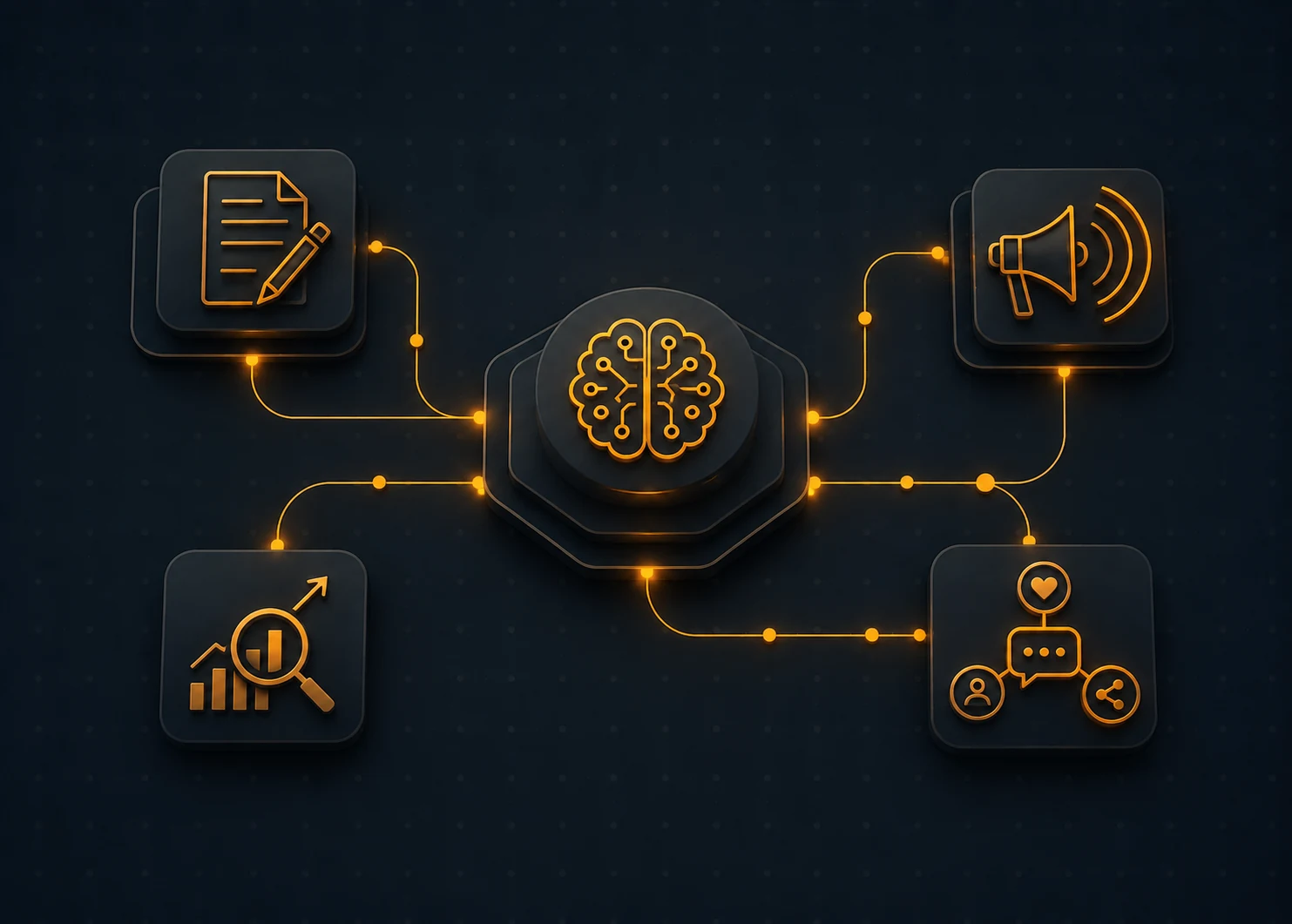
They become more useful once they can plan, create, check, publish, measure, and improve work inside one connected process, instead of producing a single output and stopping. This article covers content, SEO, campaigns, social media, governance, and how teams scale this work.
Key takeaways
- AI marketing agents complete ongoing tasks with real context, connected tools, and defined approval points.
- Best use cases are repeated, multi-tool work: content, SEO, campaigns, social, and reporting.
- Basic automation breaks once teams run disconnected tools without shared context or ownership.
- A governed platform gives each agent a defined role, controlled access, and a clear approval checkpoint.
- Start with one process, prove it, then expand into multi-agent workflows.
What Are AI Agents for Marketing?
AI agents for marketing are software systems that complete ongoing marketing tasks with limited manual input, using context and tools to plan and act. Rather than producing a single output, they combine several pieces at once:
- AI models
- Business data
- Marketing tools
- Instructions
- Memory
- Rules
- Approvals
- Actions
Put together, those pieces let an agent carry a task from a rough goal to a finished, reviewed result. A one-off prompt in a tool like ChatGPT answers a single question and then forgets everything about it. A marketing AI agent keeps the brief, the brand rules, and the outcome of the last campaign in view, and it can act inside a connected tool instead of just producing text for someone to copy and paste.
What Makes a Marketing AI Agent Useful?
What separates a useful agent from a novelty demo usually comes down to a handful of factors:
- A specific, narrow task rather than a vague, open-ended mandate
- Access to real brand and product data, not just generic training knowledge
- A working connection to the tools where the work actually happens
- Clear checkpoints where a person reviews before anything goes live
- A way to measure whether the output actually performed
How AI Agents for Marketing Work
Most marketing agent workflows follow a similar shape, whether the task is writing a blog post or launching a paid campaign.
→
Context
→
Plan
→
Action
→
Approval
→
Publish
→
Measure
→
Improve
Goal and Instructions
Every agent starts with a defined job, not an open-ended request. Example: increase qualified organic traffic by finding content gaps and managing the content workflow from brief to published draft. Without a specific goal, an agent has no way to judge whether its work is actually useful.
Marketing Context
An agent's output is only as good as the context feeding it. That context can draw on brand guidelines, product data, ICPs, past campaigns, SEO data, analytics, CRM data, and competitor information. The more of this an agent can draw on, the less it has to guess.
Connected Marketing Tools
Context alone doesn't publish anything. For an agent to act rather than just draft, it needs a working connection to the systems marketing already runs on: CMS, CRM, email, analytics, Search Console, ad platforms, social platforms, and project tools. Each connection should be scoped to what that particular agent actually needs to do.
Actions and Approvals
Depending on its role, an agent may create content, update a record, route a task to a teammate, publish a piece, or generate a report. High-impact actions - the kind that reach customers or spend budget - should still pass through an approval step before anything goes live.
Where AI Agents for Marketing Create the Most Value
The best use cases share a pattern: repeated work that spans multiple tools and follows a process a person could describe step by step.
Content Marketing
An agent can research a topic, write a brief, generate a first pass, and route it for review, cutting down manual handoff time. The writer still shapes the final piece; the agent gets a workable draft in front of them faster.
SEO
An agent connected to Search Console and analytics data can surface content deficiencies, ranking movement, and technical problems continuously instead of waiting for a monthly report.
Campaign Management
An agent can track where a campaign stands, flag a missing asset or close deadline, and pull performance data into one place. The campaign manager still makes calls on budget and strategy.
Social Media
An agent can repurpose existing content - a blog post or case study - into channel-specific formats and queue it for review on a consistent schedule.
Marketing Reporting
An agent can assemble data on a schedule and draft the narrative around it, leaving a person to check the numbers and add judgment the data alone cannot provide.
A Complete AI Marketing Agent Workflow Example
Seeing the stages in sequence makes the idea more concrete. Here is what a single content campaign might look like when it moves through a marketing agent workflow.
→
Plan
→
Create
→
Review
→
Publish
→
Promote
→
Measure
→
Improve
Set the campaign goal
The marketing leader sets a specific goal - for example, growing signups from a target segment within one quarter.
Research agent finds audience pain points
Scans support tickets, review sites, and recent customer conversations for common themes.
SEO agent identifies search opportunities
Compares keyword gaps against competitor rankings and current organic site performance data.
Content agent creates briefs and drafts
Based on the research findings and the SEO team's target keyword list.
Review agent checks brand voice and quality
Flags any claims, tone issues, or layout problems before human review.
Human approves the key assets
Confirms the messaging, claims, and creative direction match the original campaign goal.
Publishing agent pushes content live
Pushes approved content to the CMS and schedules related distribution channels.
Social agent repurposes the content
Creates platform-specific formats and queues each post for scheduled team review.
Analytics agent tracks results
Tracks traffic, engagement, and conversions, then compares against the original campaign goal.
Optimization agent recommends next action
Based on what the data shows is working or clearly underperforming.
Why Basic AI Marketing Automation Breaks at Scale
Basic automation works fine when one person owns one tool for one task. Problems show up once several teams run their own AI tools without a shared structure.
What Marketing Teams Need Beyond AI Automation
The tools described above are not the problem on their own; the problem is running them without any structure connecting them. What marketing teams need now is less about finding a better point solution and more about building something closer to an operating system for how agents work.
That layer needs to cover:
- Shared context
- Agent roles
- Approval workflows
- Connected tools
- Audit trails
- Central monitoring
- Version control
- Permission rules
How a Governed AI Agent Platform Can Run Marketing Work
A governed platform gives every agent a defined role, connects it to the right tools, and adds a checkpoint before anything reaches a customer. Harnyss is built around that idea, providing the structure marketing teams need once they move past single-purpose automations.
Give Each Marketing Agent a Defined Role
On a governed platform, each agent is scoped to one job rather than asked to do everything at once. A team might run a CMO Agent focused on strategy, an SEO Agent focused on search opportunities, a Content Writer Agent, a Market Intelligence Agent, and a Social Agent, each with its own defined responsibility.
Connect Agents to Marketing Tools
Each agent needs a controlled connection to the systems relevant to its job - CRM, analytics platform, Search Console, CMS, ad accounts, social platforms, or project tools. Scope the connection so an agent reaches only the systems and data it needs, keeping access contained.
Add Approval Workflows
High-risk outputs should require a person's approval before they go live, no matter how routine the agent's task has become. That applies to campaign launches, public content, paid ads, and customer communications.
Keep Full Audit Trails
A governed platform tracks what each agent did, which tools it touched, and who approved the resulting action. That record turns a black-box automation into something a team can actually review after the fact.
Let Agents Work Together
Individual agents become more useful once they can hand work to one another instead of operating in isolation. A typical handoff:
→
Content Writer
→
Review Agent
→
Publishing Agent
This is where governance matters most, since a mistake anywhere in that chain can move quickly through the rest without a checkpoint.
How to Implement AI Agents for Marketing
The most reliable way to implement AI agents for marketing is to start with one process, connect it, and expand from there.
Choose One Marketing Process
Start with a process the team already runs regularly, like a blog production cycle or a monthly report. A repeatable process gives the agent enough pattern to learn from.
Define the Agent's Role
Give the agent one clear responsibility instead of a broad mandate covering several jobs at once. A narrow scope makes it far easier to tell whether the agent is doing its job well.
Connect the Right Data
Provide only the context the agent needs for that specific task, not every dataset the team can access. Irrelevant context adds noise and slows review.
Connect Marketing Tools
Add the integrations required for the agent to act - CMS, analytics platform, or CRM. Each new connection should map directly to something the agent needs to do its job.
Set Permissions
Separate read access, write access, and approval rights so the agent can only do what its role requires. This keeps a drafting agent from accidentally publishing.
Add Human Review
Define upfront which actions need a person's sign-off before anything happens. High-impact actions - anything customer-facing or budget-related - should always include this step.
Test With Real Work
Run the agent against normal cases first, then test it against unusual scenarios before trusting it with live work. Edge cases tell you more than easy ones.
Measure Results
Track quality, speed, cost, and the actual business impact of the agent's work. Without this, it's hard to tell whether the agent is saving time or just moving work around.
Expand Into Multi-Agent Workflows
Add more agents only after the first process works reliably and the team trusts its output. Expanding too early is one of the more common ways these projects stall.
Common Mistakes When Using AI Agents for Marketing
Most problems with marketing AI agents trace back to a handful of avoidable mistakes.
Final Words
- AI agents for marketing complete ongoing tasks using real business context, connected tools, and defined approval points - not just a single prompt and response.
- The most valuable use cases involve repeated work across content, SEO, campaigns, social media, and reporting, not one-off, judgment-heavy tasks.
- Basic AI marketing automation tends to break down once multiple teams run disconnected tools without shared context, ownership, or an audit trail.
- A governed AI agent platform like Harnyss gives each agent a defined role, controlled tool access, and a clear approval checkpoint.
- The most reliable path forward starts with one marketing process, proves it out, and expands into multi-agent workflows from there.
Frequently Asked Questions
What are AI agents for marketing?
AI agents for marketing are software systems that complete ongoing marketing tasks using business context, connected tools, and a defined set of rules. Unlike a single AI-generated output, they can plan, act, and adjust across a multi-step process.
How are AI agents used in marketing?
Marketing teams use AI agents to research topics, draft content, track SEO performance, manage campaign details, repurpose content for social channels, and assemble reports. Each agent is typically scoped to one part of that work rather than the whole workflow.
Can AI agents automate content marketing?
AI agents can handle much of the repetitive work in content production, including research, briefs, first drafts, and routing for review. A person still shapes the final piece and approves it before publishing.
Can AI agents automate SEO?
AI agents can continuously track keyword opportunities, ranking changes, and technical issues by connecting to tools like Search Console and analytics platforms. This turns SEO monitoring into an ongoing process instead of a periodic audit.
Can AI agents manage social media?
AI agents can repurpose existing content into platform-specific formats and queue posts on a consistent schedule. They typically aren't left to publish without review, since brand voice and timing still benefit from a person's judgment.
Are AI marketing agents fully autonomous?
No, AI marketing agents are not fully autonomous in most practical setups, and high-impact actions should still require human approval. Autonomy tends to increase gradually as a team builds trust in a specific, narrow workflow.
What is the difference between AI agents and marketing automation?
Traditional marketing automation follows fixed rules and triggers. AI agents can interpret context, make judgment calls within their scope, and adjust their actions based on what they find.
How do you govern AI agents for marketing?
Governing AI agents for marketing means defining clear roles, scoping tool access, requiring approval on high-impact actions, and keeping an audit trail of what each agent did. A platform like Harnyss provides this structure rather than leaving teams to assemble it themselves.